
Notion vs ClickUp for Virtual Assistants: The Complete Comparison Guide (2026)
Disclosure: This post contains affiliate links. VA Automation Lab earns a commission if you purchase through them, at no extra cost to you. Recommendations are based on genuine evaluation of tool fit for VA workflows.
Notion vs ClickUp for virtual assistants is the most consequential tool decision a VA makes when building their operational system, and it is also the most commonly made on the wrong basis. This guide covers the complete feature comparison, the accurate pricing picture including AI add-ons, the automation gap that separates the two tools operationally, the extended tool stack that completes either choice, and the decision framework that matches each tool to specific VA service types.
Should a virtual assistant use Notion or ClickUp? ClickUp is the better primary tool for task-execution-heavy VA work (admin, project management, operations) because of native tasks, multiple views, and built-in automation. Notion is better for documentation-heavy work (content, research, knowledge management). VAs doing both should run the combined stack.
The comparison looks straightforward on the surface: both tools promise to replace multiple apps with a single workspace. Both have free plans, both have AI assistants, both support databases and documents, and both are used by virtual assistants at scale. The marketing positioning of each tool reinforces the confusion, ClickUp calls itself “the one app to replace them all,” Notion calls itself “the all-in-one workspace.”
They are not the same tool solving the same problem in different ways. They are tools built on fundamentally different operational philosophies that happen to overlap in the middle of the feature spectrum. ClickUp is task-centric: it was built from the ground up for structured project management, with tasks as the primary unit of work. Notion is document-centric: it was built for flexible knowledge management, with pages and databases as the primary unit of work. For a virtual assistant, this distinction is not semantic, it determines which tool fits which service type, which tool scales more efficiently with client count, and which tool integrates more cleanly with the automation stack.
The answer to “Notion vs ClickUp for virtual assistants” is not universal. It depends on what the VA primarily delivers, how many clients they manage, and whether their highest-friction daily task is task execution or documentation. This guide provides the data, the comparison, and the framework to answer it correctly for your specific situation.
What this guide covers:
- The fundamental difference between Notion and ClickUp and why it matters for VA operations
- Notion vs ClickUp features, side-by-side comparison across eight categories
- Notion vs ClickUp pricing, the real cost for solo VA use including AI features
- Notion vs ClickUp workflow comparison, how each tool performs for the five highest-frequency VA task types
- The automation gap and how to bridge it
- The complete VA tool stack, what extends either choice into a full operational system
- The VA-specific decision framework, which tool for which service type
- The combined stack, when to use both
👉 AI Tools for Virtual Assistants: The Complete Practical Guide — the full reference for every AI tool category in VA operations.
ClickUp or Notion can organize your work, but they don’t operate in isolation. The Complete Comparison Guide to the Best Tools for Virtual Assistants shows how to combine them with the right scheduling, automation, CRM, and billing tools to build a complete, high-efficiency VA system.
Want to Start Using AI Tools the Right Way?
If you want to scale your VA business with clean systems, automation, and AI‑powered workflows, start with our free weekly insights.
Download once. Route every task correctly from day one.
Table of Contents
1. The Fundamental Difference Between Notion and ClickUp
Understanding the Notion vs ClickUp comparison correctly requires starting with the architectural difference, the design philosophy that shapes every feature, every limitation, and every workflow implication of each tool.
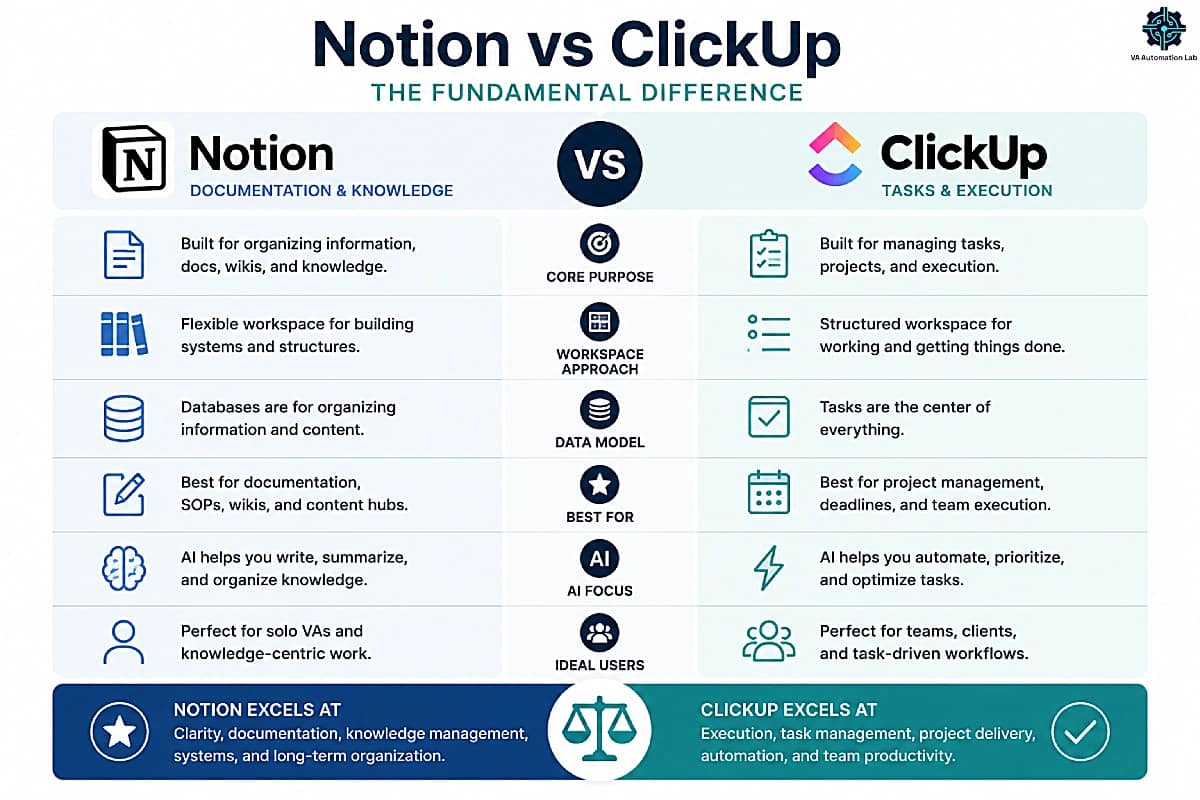
ClickUp is task-centric. Every element in ClickUp is ultimately a task or a container for tasks. Spaces, Folders, and Lists are the structural hierarchy, each level a container that organizes tasks below it. Documents, whiteboards, and dashboards exist in ClickUp, but they are satellite features built around the task management core. When you open ClickUp, you see tasks. The primary action is creating, assigning, tracking, and completing work items.
Notion is document-centric. Every element in Notion is ultimately a page or a database. Pages contain structured content: text, tables, embedded databases, linked views. Tasks exist in Notion, but they are implemented as database rows, not native task objects. When you open Notion, you see pages. The primary action is creating, organizing, and retrieving structured information.
Why this matters for VA operations
A VA’s daily work is split between two fundamentally different operational modes:
Execution mode — processing tasks, meeting deadlines, tracking deliverables, managing recurring work. This mode benefits from ClickUp’s native structure: task statuses, due dates, priorities, dependencies, recurring tasks, and time tracking are all first-class features that require no configuration.
Documentation mode — writing SOPs, building client wikis, organizing reference material, storing meeting notes, creating templates. This mode benefits from Notion’s native structure: flexible page hierarchies, relational databases, and the Ask Notion AI feature that makes the entire documentation library queryable.
The correct tool for a given VA is determined by which mode dominates their daily operations. A VA whose primary deliverables are task execution, project management, and client deliverables tracking spends 70-80% of their time in execution mode, ClickUp is the correct primary tool. A VA whose primary deliverables are content creation, documentation, research, and knowledge management spends 70-80% of their time in documentation mode, Notion is the correct primary tool. A VA doing both at high volume, the majority of experienced VAs managing multiple clients with diverse service scopes, needs both, configured to work together rather than competing for the same operational territory.
Notion | ClickUp | |
Primary unit of work | Page / Database row | Task |
Core strength | Knowledge management + documentation | Project management + task execution |
Setup approach | Build from blank canvas | Structured system out of the box |
Learning curve | Moderate — flexible but requires design decisions | Steeper initial setup, clearer initial structure |
Best fit | Documentation-heavy VA services | Task-execution-heavy VA services |
2. Notion vs ClickUp Features — Eight-Category Comparison
The Notion vs ClickUp features comparison below covers the eight categories most relevant to VA operations, ranked by operational impact for solo VA use.
Category 1 — Task Management
ClickUp: Native, first-class task management. Tasks have statuses, priorities, due dates, time estimates, time tracking, dependencies, subtasks, and recurring schedules built in. Multiple task views (List, Board, Gantt, Calendar, Timeline, Workload) switch without data duplication. Recurring tasks are scheduled automatically with future instances visible. Task templates reduce setup time for repeating work types.
Notion: Task management via database. A task database can replicate most ClickUp functionality (status, priority, due date, assignee) but every feature requires manual configuration. Recurring tasks require workarounds (manual duplication or third-party tools). No native time tracking. No native Gantt or timeline without third-party extensions.
Winner for VAs: ClickUp, by a significant margin for task management as the primary use case. Notion’s task management is functional for simple single-client use but does not scale efficiently to multi-client operations without significant custom configuration.
Category 2 — Documentation and Knowledge Base
Notion: Native, first-class documentation. Pages are infinitely nestable and composable (text, tables, databases, embedded content, callouts, toggles) all in one flexible canvas. A Notion workspace naturally becomes a searchable knowledge base. Ask Notion queries the entire workspace in natural language. Client wikis, SOP libraries, onboarding documents, and meeting note archives are all native Notion use cases.
ClickUp: Documentation via Docs feature. ClickUp Docs supports rich text, tables, and page nesting. Adequate for most document types. Connected Search finds content across Docs and tasks. The documentation layer is less flexible than Notion’s, complex relational structures require more configuration.
Winner for VAs: Notion, for documentation and knowledge base as the primary use case. ClickUp Docs handles routine documentation adequately but cannot match Notion’s flexibility for complex client wikis and multi-relational database structures.
Category 3 — Database and Relational Structures
Notion: Databases are Notion’s operational core. Table, Board, Gallery, List, Calendar, and Timeline views of the same database. Relations link databases bidirectionally, a task in the Task database can relate to a row in the Client database, which relates to rows in the Meeting Notes database. Rollups aggregate data across linked databases automatically. This relational layer is powerful for VAs who build structured client management systems in Notion.
ClickUp: Relational structures via Custom Fields and Relationships. Less flexible than Notion’s relational database model but sufficient for most VA operational needs. The ClickUp hierarchy (Space > Folder > List) provides structural organization that replaces some relational functionality for task management contexts.
Winner for VAs: Notion, for complex relational data structures. For simple task-linked data, ClickUp’s Custom Fields are sufficient.
Category 4 — Native Automation
ClickUp: Native automation builder included on paid plans. “If/then” rules with triggers (status change, date arrival, task creation, field update) and actions (assign, move, change status, create task, send notification). Pre-built automation templates for common workflows. Covers the recurring-task and status-change automation needs of most VA operations without requiring Zapier or Make.
Notion: No native automation as of 2026. Button automations (trigger a sequence from a manual button click) and basic database automation (auto-set properties on creation) are available on paid plans. For cross-platform or time-triggered automation, Zapier or Make is required.
Winner for VAs: ClickUp, decisively. The absence of time-triggered native automation in Notion is the single largest operational gap for VAs who need workflows to run automatically without manual triggers.
Category 5 — Views and Visual Planning
ClickUp: List, Board (Kanban), Gantt, Calendar, Timeline, Workload, Table, Mind Map, Whiteboard, all as views of the same underlying task data. Switch between views without data migration. The Workload view is particularly valuable for multi-client VAs, it shows task distribution across time and identifies overload periods visually.
Notion: Table, Board, Gallery, List, Calendar, Timeline views of database data. No Gantt native. No Workload view. Multiple databases can be displayed on the same page via linked views, giving a dashboard effect without true cross-database aggregation.
Winner for VAs: ClickUp, for task planning and workload visualization. For database views and flexible page layouts, Notion is more flexible.
Category 6 — Collaboration and Client Sharing
ClickUp: Guest access on paid plans. Clients can be given limited access to specific lists or tasks. Real-time collaboration on Docs. Comments and @mentions on tasks. Native chat feature for team communication.
Notion: Guest access on all plans (limited on Free). Clients can be given read or edit access to specific pages or entire workspaces. Notion sharing is particularly clean for client-facing portals, a shared Notion page renders cleanly in a browser, the client accesses the content without creating a Notion account.
Winner for VAs: Notion, for clean client-facing sharing. ClickUp is more functional for internal team collaboration.
Category 7 — Mobile Experience
ClickUp: Full-featured mobile app. Task creation, status updates, and notifications work well on mobile. The interface is dense, less comfortable for reading and documentation tasks on small screens.
Notion: Mobile app focused on reading and light editing. Database views and page navigation work well. Heavy editing and complex database management are better suited to desktop.
Winner for VAs: Tie, both have functional mobile apps with different strengths. ClickUp mobile for task updates on the go; Notion mobile for reference and review.
Category 8 — Performance and Reliability
ClickUp: Can feel sluggish on large workspaces with many automations and custom fields. Performance degrades with workspace complexity, a known limitation at scale. Desktop app generally performs better than the browser version.
Notion: Generally faster for navigation and page loading. Performance is more consistent across workspace sizes. Large databases with many linked relations can slow down on older hardware.
Winner for VAs: Notion, for consistent performance. ClickUp’s performance issues are a real operational consideration for high-volume VA workspaces.
Category | Notion | ClickUp | Winner (VA context) |
Task Management | ⚠️ Via database | ✅ Native, full-featured | ClickUp |
Documentation | ✅ Native, flexible | ⚠️ Adequate via Docs | Notion |
Database / Relations | ✅ Advanced relational | ⚠️ Basic via Custom Fields | Notion |
Native Automation | ❌ Limited | ✅ Built-in if/then rules | ClickUp |
Views / Visual Planning | ⚠️ Basic views | ✅ 9 view types + Workload | ClickUp |
Client Sharing | ✅ Clean guest access | ⚠️ Requires account | Notion |
Mobile | ⚠️ Reading/reference | ⚠️ Task updates | Tie |
Performance | ✅ Consistent | ⚠️ Degrades at scale | Notion |
3. Notion vs ClickUp Pricing — The Real Cost for VAs
Notion vs ClickUp pricing looks comparable at the plan level, both offer a free tier and paid plans in the $7-20//month range. The real cost picture for VAs changes significantly when AI features are included, because both tools monetize their AI layers differently.
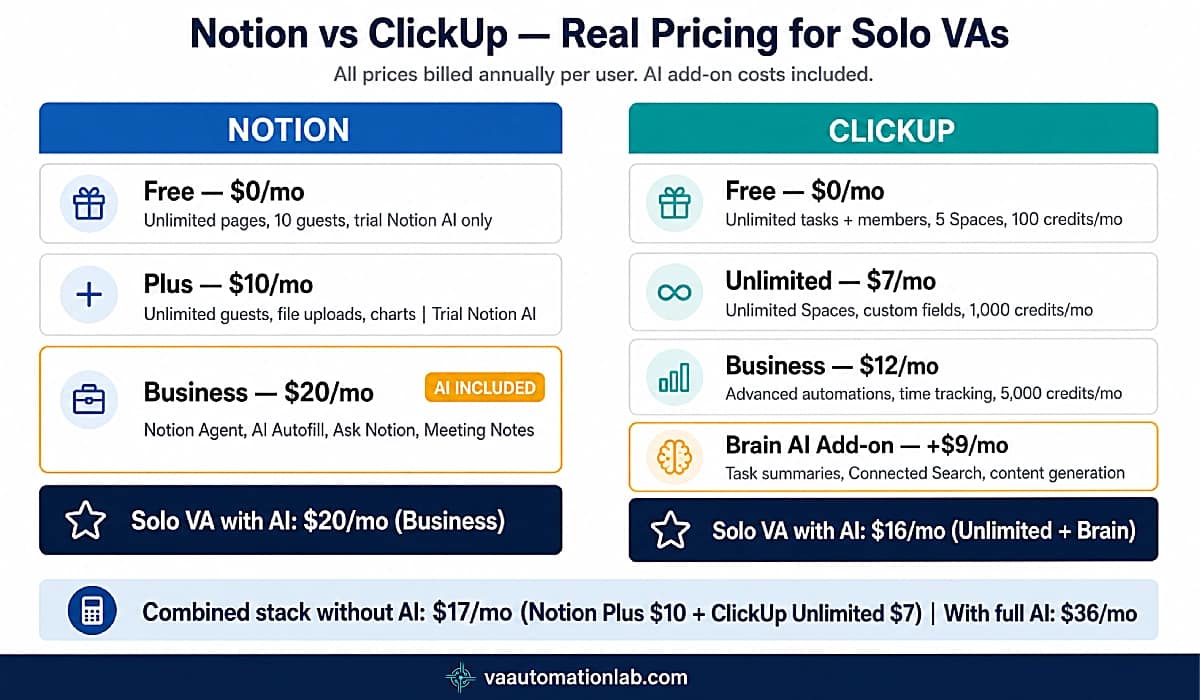
Plan | Notion | ClickUp |
Free | Unlimited pages + blocks (solo), 10 guests, trial of Notion AI | Unlimited tasks + members, 5 Spaces, 100MB storage, 100 automation executions/mo |
Plus/Unlimited | $10/user/mo (annual) — unlimited guests, file uploads, unlimited charts, trial of Notion AI | $7/user/mo (annual) — unlimited storage, custom fields, 1,000 automation executions/mo |
Business | $20/user/mo (annual) — Notion Agent, AI Meeting Notes, Enterprise Search, advanced analytics, SAML SSO | $12/user/mo (annual) — advanced automations, time tracking, workload view, 5,000 automation executions/mo |
AI Add-on | Notion AI: included in Business (Notion Agent; Custom Agents use Notion credits at $10/1,000) | ClickUp Brain: +$9/user/mo with 1,500 AI Super Credits; Everything AI tier +$28/user/mo |
Solo VA effective cost with AI | $20/mo (Business — AI included) | $16/mo (Unlimited $7 + Brain $9) |
The AI cost comparison for solo VAs:
At the entry AI tier, ClickUp is cheaper: $16/month (Unlimited $7 + Brain $9) covers the Brain Assistant, AI chat, writing, Connected Search, task summaries, and 1,500 AI Super Credits/month. Notion bundles its full standard AI suite into the Business plan at $20/month. The comparison flips at the top tier — ClickUp’s Everything AI (AI Notetaker, image generation, unlimited AI Fields and Automations) is $28/month on top of the $7 plan, or $35/month total, while Notion’s AI stays at $20.
What each price point includes:
ClickUp $16/month (Unlimited + Brain): Full task management, 1,000 automations/month, time tracking, custom fields, ClickUp Brain for task summaries and content generation, Connected Search across workspace and connected tools.
Notion $20/month (Business): Full documentation features, advanced database functionality, Notion Agent, Ask Notion workspace Q&A, AI Meeting Notes, AI Autofill in databases, Enterprise Search, and advanced analytics.
The Free plan reality for VAs:
ClickUp Free is more generous for task management: unlimited tasks, unlimited members, 100 automation executions/month, and 5 Spaces make it viable for a solo VA managing one or two clients. The 5 Space limit becomes a constraint as the client roster grows.
Notion Free is more generous for solo documentation use: unlimited pages and blocks for a single user. Notion AI is available only as a trial on Free and Plus, the full feature set requires Business.
Recommendation by budget:
- $0/month: Notion Free for documentation, ClickUp Free for task management. Use both free plans as the starting stack.
- $12–20/month: ClickUp Unlimited + Brain ($16/mo) if the primary need is task management and automation. Notion Business ($20/mo) if the primary need is AI-enhanced documentation and knowledge management.
- $27+/month: Both tools on paid plans for the full combined stack. ClickUp Unlimited ($7) + Notion Plus ($10) = $17/month without AI; ClickUp Unlimited + Brain ($16) + Notion Business ($20) = $36/month with both AI assistants (Notion’s full suite plus ClickUp Brain).
4. Notion vs ClickUp for the Five Highest-Frequency VA Tasks
The abstract feature comparison matters less to a VA’s daily experience than the question: which tool performs better for the specific tasks I do most often? The five categories below represent the highest-frequency operational tasks across VA service types.
Category | VA Task | Winner | Reason |
Multi-Client Task Management | Tracking, priorities, cross-client overview | ClickUp | Native Task Structure |
SOP & Document Creation | Process docs, wikis, knowledge base | Notion | Flexible Page Structure |
Client Communication & Reports | Weekly updates, status reports | Notion + ClickUp | Different Layers, Same Report |
Client Onboarding | Task setup + documentation layer | Notion + ClickUp | Best Used Together |
Content Calendar Management | Editorial planning, client sharing | Notion | Clean Client Sharing |
Task 1 — Multi-Client Task Management and Tracking
ClickUp performance: Excellent. One Space per service category, one Folder for Client Work, one List per client duplicated from template. The cross-client dashboard using the Everything View shows all tasks across all client lists with filtering by due date, priority, and assignee. Recurring tasks automate weekly and monthly deliverables. The Workload view shows capacity across all clients simultaneously. Setup time: 2-3 hours initially, 5-10 minutes per new client from template.
Notion performance: Functional with configuration. A Master Task Database with a Client property and filtered views per client replicates most ClickUp functionality. Cross-client overview requires a linked database view on a dashboard page, achievable but requires 3-5 hours of initial configuration. No native workload view. Recurring tasks require manual duplication or a Make automation.
Verdict: ClickUp is the correct tool for multi-client task management. The native structure handles the architecture without configuration overhead.
Task 2 — SOP Creation and Documentation
Notion performance: Excellent. Pages and sub-pages create a natural SOP library hierarchy. Notion AI generates SOP first drafts from process descriptions instantly. Ask Notion retrieves specific SOPs from the library by natural language query. Client-specific SOP variants are linked relational rows in the same database, visible in filtered views per client.
ClickUp performance: Functional. ClickUp Docs handles SOP creation and organization. The documentation layer is less flexible than Notion’s, complex linking between SOPs and related tasks requires custom field configuration. ClickUp Brain can generate SOP content. Search finds documents across the workspace.
Verdict: Notion is the correct tool for SOP creation and documentation as the primary use case.
Task 3 — Client Communication and Weekly Reports
Both tools: Neither Notion nor ClickUp is the primary tool for client communication, that role belongs to Gmail and the AI drafting tools (ChatGPT or Claude). Both tools support the reporting preparation layer: ClickUp provides the completed task data that feeds the report; Notion provides the documentation context and client history that informs the narrative.
ClickUp advantage: The completed tasks for a given week are directly visible in ClickUp filtered by completion date, easier to pull into a Make scenario that auto-generates weekly reports.
Notion advantage: The client wiki and meeting notes history in Notion provides richer context for narrative reporting than a task list alone.
Verdict: Both tools contribute to the reporting workflow at different layers.
👉 How to Automate Client Reporting as a Virtual Assistant — the complete workflow.
Task 4 — Client Onboarding
ClickUp performance: A ClickUp List template duplicated for each new client creates the complete task structure instantly. Combined with Make automation (form submission → ClickUp list creation), the operational onboarding is near-fully automated. The template stores the standard onboarding task sequence with correct statuses, assignees, and due date logic.
Notion performance: A Notion page template duplicated for each new client creates the client wiki structure instantly. Combined with a Zapier automation, the documentation layer of onboarding is automated. The template stores the client profile, services agreement reference, SOPs, and meeting notes structure.
Verdict: Both tools are valuable for different layers of the onboarding process, ClickUp for the task and workflow layer, Notion for the documentation and knowledge layer. This is the strongest argument for using both tools in combination.
👉 How to Automate Client Onboarding for Virtual Assistants — the complete onboarding automation workflow using both tools.
Task 5 — Content Calendar and Social Media Management
Notion performance: Excellent. A content calendar database with Title, Platform, Status, Publish Date, and Content fields replicates a full editorial calendar. AI Autofill generates captions and content angles from the topic and audience fields automatically. Gallery view provides a visual calendar layout. Clients can be given read or edit access to the calendar without a paid seat.
ClickUp performance: Functional. A ClickUp List configured as a content calendar with custom fields for Platform, Status, and Content works well. The Calendar view provides scheduling visibility. Less flexible than Notion for rich text content storage per calendar item.
Verdict: Notion is the correct tool for content calendar management, particularly for VAs sharing the calendar directly with clients.
5. The Automation Gap
The automation capability difference between Notion and ClickUp is the single most important operational consideration for virtual assistants who want to build a genuinely scalable workflow system.
ClickUp’s native automation: ClickUp includes an if/then automation builder on paid plans. Common VA automation use cases that work natively in ClickUp:
- When task status changes to “Done” → move to Completed list → notify via email
- When due date arrives → change priority to Urgent → assign to VA
- When new task is created in client list → set default assignee and due date
- Weekly recurring task creation on specified day and time
- Monthly report task auto-creation with subtask structure
These automations run inside ClickUp without any external tool. For a VA managing 4-5 clients, ClickUp’s native automations handle 60-70% of the workflow automation needs at zero additional cost.
Notion’s automation limitation: Notion has no time-triggered native automations. The button automations allow a sequence of database actions to run from a manual button click, useful but not automated. For any workflow that needs to run on a schedule (weekly report generation, recurring task creation, reminder sequences), Notion requires Make or Zapier as the automation layer.
The practical implication:
A VA using Notion as their primary operational hub needs to budget for and configure Make or Zapier to handle the automation layer that ClickUp provides natively. A VA using ClickUp can handle most task-layer automation without any additional tools.
This does not make Notion the wrong choice for a documentation-heavy VA, it means the total system cost and complexity for a Notion-primary stack is higher than for a ClickUp-primary stack, because the automation layer requires an additional tool.
Automation Type | ClickUp Native | Notion Native | Requires Make/Zapier |
Status change trigger | ✅ | ❌ | ❌ |
Due date trigger | ✅ | ❌ | ❌ |
Recurring task creation | ✅ | ❌ | ❌ |
New row auto-property | ✅ | ✅ (limited) | ❌ |
Button-triggered sequence | ✅ | ✅ | ❌ |
Cross-platform automation | ❌ | ❌ | ✅ |
Email/Slack notification | ✅ | ❌ | ✅ |
👉 Best Automation Workflows for Virtual Assistants — the complete guide to building the automation layer for both Notion and ClickUp operations.
Automate the Bridge Between ClickUp and Notion
Make is the automation layer that turns the combined stack into a self-running system, syncing completed tasks to Notion logs, creating client wikis on intake form submission, and sending weekly reports without manual effort.
The free plan handles 1,000 credits/month, which covers the core combined-stack scenarios for a VA managing 2–3 clients.
The Core plan at $9/month removes the 15-minute run interval and is the correct upgrade point when the stack grows.
6. Notion vs ClickUp AI Features
Both tools have AI assistants, Notion AI and ClickUp Brain, built natively into their workspaces. For VAs evaluating the best project management tool for virtual assistants on AI capability, the comparison reveals tools designed for different primary functions.
Notion AI
Notion AI is a writing and knowledge assistance layer built on top of the Notion workspace. Its three highest-value features for VAs:
AI Summaries — summarize any page or database into a structured brief in seconds. Meeting notes to action items, research pages to executive summaries, weekly activity logs to client update drafts.
Ask Notion — query the entire workspace in natural language. “What are the open tasks for Client A?” “Which SOPs cover the invoicing process?” “Summarize all decisions from last month’s meetings.” The answer is generated from the actual content in the workspace.
AI Autofill — auto-populate database columns based on existing row content. Configure once per property, runs automatically on all new rows. Content calendar captions from topic fields, task priority from description content, client status from linked meeting notes.
Limitation: Reactive Notion AI (chat, summaries, autofill) works on workspace content only. The autonomous layer reaches further — Notion Agent is included in Business, while Custom Agents and Workers (which can sync external data and trigger workflows) run on Notion credits at $10 per 1,000.
Cost: Included in the Business plan ($20/month) — Notion AI Core, Enterprise Search, Research mode, Meeting Notes, and Notion Agent. Custom Agents are included but consume Notion credits ($10 per 1,000).
ClickUp Brain
ClickUp Brain is a task and project management AI assistant. Its three highest-value features for VAs:
Connected Search — searches across ClickUp tasks, Docs, and connected external tools simultaneously. Find information without knowing where it lives.
Task Summaries — summarize any project, list, or task cluster into a status report. “Summarize the current status of all Client A tasks” produces a narrative overview from the actual task data.
Content Generation — generate task descriptions, project plans, status updates, and meeting agendas from brief inputs. Similar to ChatGPT but with workspace context.
Meeting Notetaker — automatically captures, summarizes, and creates action items from meetings recorded or uploaded to ClickUp. The unlimited AI Notetaker is part of the higher Everything AI tier rather than base Brain.
Limitation: ClickUp Brain’s strongest features are task and project-oriented. For open-ended writing, complex document generation, or documentation-heavy work, ChatGPT or Claude produces better outputs.
Cost: $9/user/month add-on on any paid plan — an unlimited Brain Assistant, @Brain Agent, AI chat (Claude, ChatGPT, Gemini), and AI writing, plus 1,500 AI Super Credits/month for agents and automations. The Everything AI tier ($28/user/month) adds the AI Notetaker, image generation, unlimited AI Fields and Automations, and 5,000 Super Credits. Effective cost for a solo VA with AI: $16/month (Unlimited $7 + Brain $9).
AI Feature | Notion AI | ClickUp Brain |
Writing assistance | ✅ Strong | ✅ Adequate |
Page/document summaries | ✅ Excellent | ⚠️ Via Docs |
Workspace Q&A | ✅ Ask Notion | ✅ Connected Search |
Task summaries | ⚠️ Via database queries | ✅ Native |
Database autofill | ✅ AI Autofill | ⚠️ AI Fields (Everything AI) |
External tool search | ❌ Workspace only | ✅ Connected Search |
Autonomous agents | ✅ Notion Agent + Custom Agents (credits) | ✅ @Brain Agent + Super Agents (credits) |
Meeting notes | ✅ (Business) | ⚠️ AI Notetaker (Everything AI) |
Best for | Documentation + knowledge retrieval | Task management + project context |
👉 Notion AI for Virtual Assistants: Complete Guide — the full Notion AI feature guide with prompt templates and workflows.
👉 ClickUp for Virtual Assistants: Setup Guide — the complete ClickUp configuration guide for VA operations.
Want a smarter workspace for content, SOPs, and client documentation?
With Notion, you can build a fully customized system for your VA business, from knowledge bases to content pipelines.
✨ Exclusive offer: Get 3 months of Notion with all AI features (Notion Agent, AI Autofill, Ask Notion, and AI Meeting Notes) included for free
✔ Create SOPs, dashboards, and client portals
✔ Use AI to write, summarize, and organize content
✔ Keep everything in one clean, flexible workspace
7. Notion vs ClickUp for Multi-Client Management
Multi-client management is where the Notion vs ClickUp for virtual assistants decision has the most concrete operational consequences. The structural requirements of managing four to six simultaneous client engagements test both tools at their respective limits.
ClickUp multi-client structure: One Space → “Client Work” Folder → one List per client (from Client List Template). The Everything View aggregates all tasks across all client lists with full filtering. The Dashboard view provides cross-client KPIs. New client onboarding duplicates the template list, 5 minutes of setup. This structure scales from 2 to 10 clients without architectural changes.
Notion multi-client structure: One Master Database → Client property → filtered views per client. Or: one database per client in a shared Client Work database. Or: one page per client in a Client Hub. Notion provides three valid architectures for multi-client management, the flexibility is an advantage for VAs who want custom structures but a disadvantage for VAs who want a reliable out-of-the-box system.
The cross-client visibility problem:
The highest multi-client management challenge, seeing all tasks from all clients in a single prioritized view, is solved differently by each tool:
ClickUp’s Everything View with “Group by Priority” and filtered by “Due this week” provides this view natively, in under 10 seconds of configuration.
Notion requires a filtered linked database view on a dashboard page, achievable but requires 30-45 minutes of configuration and is less dynamically responsive to real-time changes than ClickUp’s view.
For VAs where multi-client task visibility is the primary operational challenge, ClickUp solves it faster and more reliably.
👉 How to Manage Multiple Clients as a Virtual Assistant — the complete multi-client management framework for VA operations.
8. The VA-Specific Decision Framework
The best project management tool for virtual assistants is not determined by a generic feature ranking, it is determined by the specific service type and workflow structure of the individual VA. The framework below provides a direct answer for each VA profile.
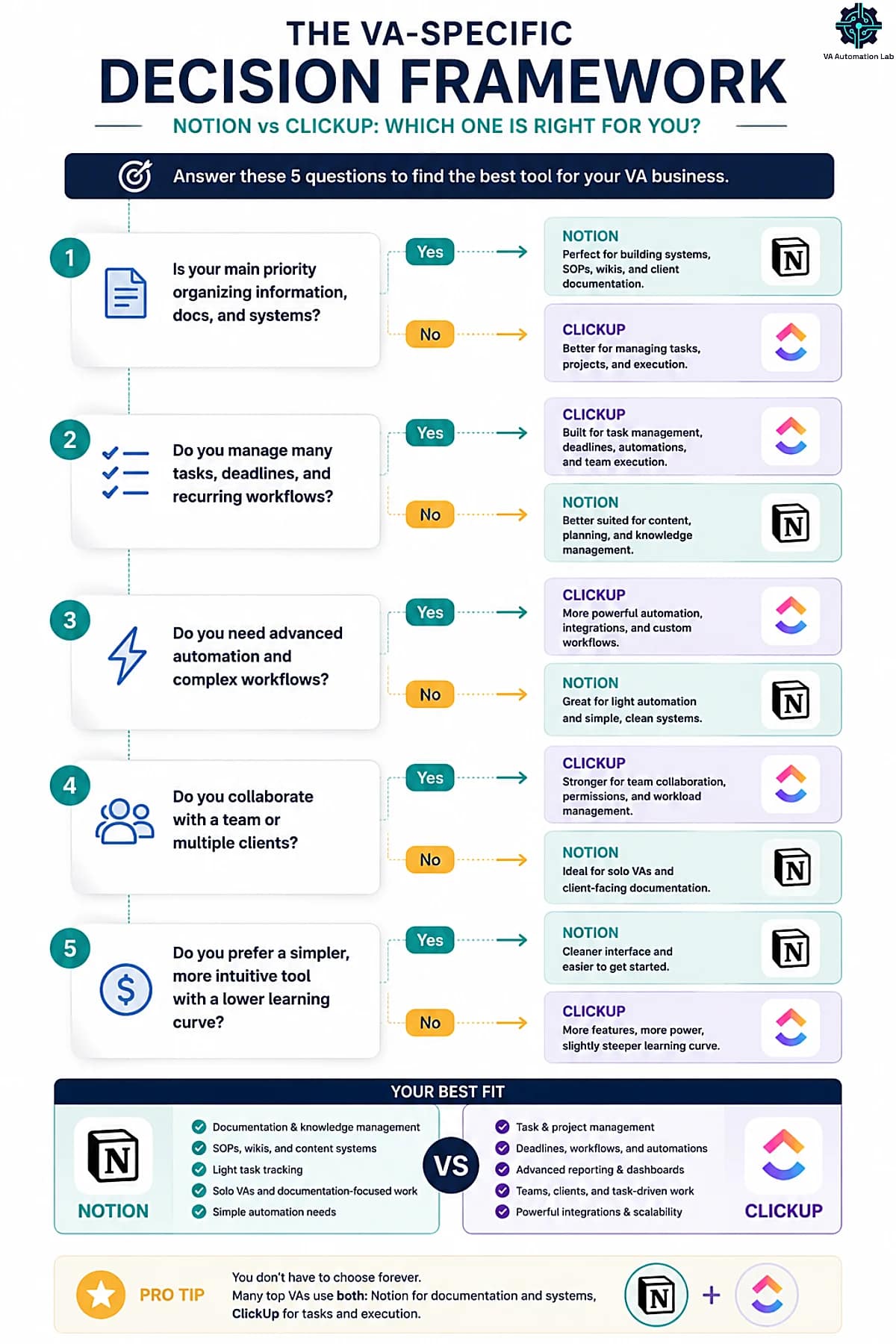
Profile 1 — The Admin VA
Primary services: inbox management, scheduling, task tracking, client updates, data entry, document organization.
Primary operational mode: execution (70-80% of daily time spent on task work).
Correct primary tool: ClickUp. The work is task-centric. Native task statuses, recurring tasks, automated reminders, and cross-client task views directly address the daily operational structure. Notion as secondary tool for SOPs and client reference documentation.
Profile 2 — The Content VA
Primary services: content creation, social media management, content calendars, newsletter management, blog posts, repurposing.
Primary operational mode: documentation and creation (60-70% of daily time spent creating and organizing content).
Correct primary tool: Notion. The work is documentation-centric. Content databases, editorial calendars, client brand guides, AI Autofill for content generation, and clean client sharing make Notion the natural fit. ClickUp as secondary tool for deadline tracking and deliverable management.
Profile 3 — The Operations VA
Primary services: SOP creation, process documentation, system setup, automation building, onboarding management.
Primary operational mode: mixed (50% documentation, 50% execution).
Correct primary tool: Both. The work requires both documentation depth (Notion) and automation and task management (ClickUp). Use Notion as the knowledge base and documentation hub; use ClickUp as the task execution and automation hub.
Profile 4 — The Project Management VA
Primary services: project coordination, deadline management, client dashboards, status reporting, team coordination.
Primary operational mode: execution and reporting (75% task-oriented work).
Correct primary tool: ClickUp. ClickUp’s native Gantt, Timeline, Workload, and Dashboard views are the correct tools for this service type. The reporting workflows (completed tasks → AI summary → weekly report) run natively with ClickUp Brain and Make automation.
Profile 5 — The Executive VA
Primary services: calendar management, inbox management, research, meeting prep, client briefings, decision support.
Primary operational mode: mixed, with high documentation requirements.
Correct primary tool: Both. The research, briefing, and documentation layer belongs in Notion (Ask Notion for knowledge retrieval, Notion AI for document generation). The scheduling, task tracking, and deadline management layer belongs in ClickUp.
VA Profile | Primary Tool | Secondary Tool | Automation |
Admin VA | ClickUp | Notion (SOPs) | ClickUp native + Make |
Content VA | Notion | ClickUp (deadlines) | Make |
Operations VA | Both (equal) | — | Make primary |
PM VA | ClickUp | Notion (docs) | ClickUp native + Make |
Executive VA | Both (equal) | — | Make + Zapier |
9. The Combined Stack — When to Use Both
The most effective decision for an experienced VA managing multiple clients with diverse service scopes is not a choice between the two tools, it is a combined stack where each tool handles the operational territory it was built for.
The combined stack configuration:
Notion as the knowledge layer:
- Client wikis and reference documentation
- SOP library (all processes documented here)
- Meeting notes and decision logs
- Content calendars and brand guides
- Onboarding documentation templates
ClickUp as the execution layer:
- All active tasks across all clients
- Recurring task schedules
- Deadline tracking and priority management
- Native automations (status changes, due date triggers, recurring creation)
- Weekly planning and cross-client overview
The connection between the two: Each ClickUp client list contains a description field with the Notion client wiki URL, clicking from the task context to the documentation context takes one click. Notion client wiki pages contain a linked ClickUp view (embed) showing that client’s active tasks, making the documentation hub also a task visibility point.
Build sequence for new VAs:
- Set up Notion with the master client database structure first (documentation foundation)
- Set up ClickUp with the client list template structure (execution foundation)
- Connect each ClickUp client list to the corresponding Notion wiki
- Build the automation layer, Make scenarios that pull ClickUp completed tasks into Notion weekly logs, trigger recurring tasks, and connect both tools to email and calendar
10. The Complete VA Tool Stack — Extending ClickUp and Notion
ClickUp and Notion cover the task execution and documentation layers of VA operations. A complete, monetization-ready VA business needs four additional tool categories that neither ClickUp nor Notion addresses natively. The stack below extends both tools without duplicating their functionality.
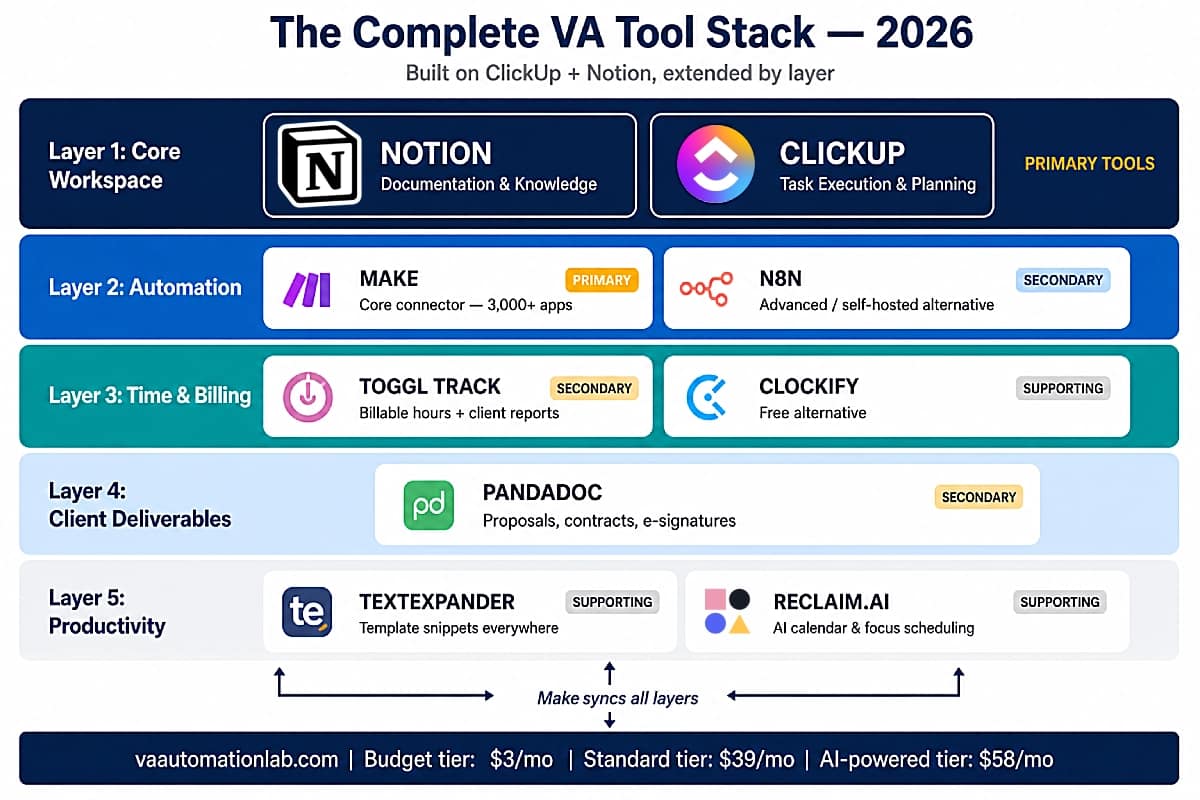
Automation
Make is the automation layer that bridges ClickUp and Notion with everything else in the VA tech stack. Where ClickUp’s native automation handles task-layer workflows internally, Make handles cross-platform workflows: completed ClickUp tasks syncing to Notion weekly logs, intake form submissions creating ClickUp task lists and Notion client wikis simultaneously, and calendar events triggering task creation in both tools.
The free plan (1,000 credits/month) handles the core combined-stack scenarios for a VA managing 2–3 clients. The Core plan at $9/month removes the 15-minute run interval limit, necessary for responsive automations.
For VAs already comfortable with automation who want more flexibility or self-hosting: n8n ($23/month Starter) provides more complex workflow logic and a node-based builder with 400+ integrations. It’s a steeper learning curve than Make but gives more control over data transformation. Make is the recommended starting point, switch to n8n only if you hit Make’s scenario complexity ceiling.
Time Tracking and Billing
Neither ClickUp nor Notion solves the billable-hours problem cleanly for solo VAs. ClickUp has native time tracking (paid plans), but the reporting is optimized for teams, not solo billing workflows. Notion has no native time tracking.
Toggl Track fills this layer at $10/month (Starter). It tracks time across all clients with one-click start/stop, generates per-client time reports that feed directly into invoice creation, and integrates with both ClickUp (via Make) and Notion (via API or Make). The free plan (unlimited tracking, basic reports) is genuinely useful for up to 5 clients without paying.
Clockify is the free alternative if budget is the primary constraint, the free plan includes unlimited tracking, timesheet export, and basic billable rates. Both integrate with Make for automated invoice data pipelines.
Client Proposals and Contracts
ClickUp and Notion store work but do not send proposals or collect contract signatures. For VAs onboarding clients, a dedicated proposal-to-signature tool removes the friction from the closing process.
PandaDoc ($19/month Starter, or free for up to 5 documents/month) handles proposals, contracts, and e-signatures in a single workflow. The Business plan ($49/month) adds CRM integrations and approval workflows, relevant for VAs managing clients’ document workflows as a service. Connect PandaDoc to Make to trigger a ClickUp client onboarding task list the moment a contract is signed.
Practical setup: Build one proposal template in PandaDoc, connect it to a Make scenario that creates the ClickUp client list and the Notion client wiki on signature. Onboarding starts automatically when the contract closes.
Productivity and Shortcuts
VAs managing multiple clients send near-identical messages hundreds of times per month, status update responses, scheduling confirmations, meeting follow-ups, invoice reminders. TextExpander ($3/month Individual) turns abbreviations into full templates instantly in any application, ClickUp task comments, Notion page text, Gmail, Slack, and every other tool in the stack.
A library of 20–30 VA-specific snippets (client greeting templates, weekly report intros, invoice payment reminders, SOP confirmation messages) eliminates 30–45 minutes of daily retyping. It works across all operating systems and browsers without changing any existing tool.
AI Scheduling
Both ClickUp and Notion integrate with Google Calendar, but neither automatically defends focus time or intelligently schedules tasks around existing commitments. Reclaim.ai (free Lite plan; Starter $10/month) analyzes your calendar, task list, and habits to schedule blocks automatically, protecting deep work time while keeping client-facing slots available.
For VAs managing scheduling as a service, Reclaim’s scheduling links and Smart Meetings features provide a level of calendar intelligence that Calendly and manual calendar management do not. Connect Reclaim to ClickUp tasks via Make to auto-schedule task work blocks when tasks are created.
Recommended Stack by VA Profile
VA Profile | Core Tools | Automation | Time/Billing | Productivity |
Admin VA | ClickUp + Notion | Make | Toggl Track | TextExpander |
Content VA | Notion + ClickUp | Make | Clockify | TextExpander |
Operations VA | Notion + ClickUp | Make + n8n | Toggl Track | TextExpander |
PM VA | Notion + ClickUp | Make | Toggl Track | TextExpander |
Executive VA | Notion + ClickUp | Make | Toggl Track | Reclaim.ai |
Estimated monthly cost for a fully operational combined stack (solo VA):
- Budget tier: ClickUp Free + Notion Free + Make Free + Clockify Free + TextExpander ($3) = $3/month
- Standard tier: ClickUp Unlimited ($7) + Notion Plus ($10) + Make Core ($9) + Toggl Track Starter ($10) + TextExpander ($3) = $39/month
- AI-powered tier: ClickUp + Brain ($16) + Notion Business ($20) + Make Core ($9) + Toggl Track Starter ($10) + TextExpander ($3) = $58/month
Build Your VA Task System in ClickUp
ClickUp’s free plan supports unlimited tasks and basic automations, enough to manage your first 2–3 clients without paying.
The Unlimited plan at $7/month removes the 5 Space limit and unlocks custom fields, 1,000 automations/month, and all view types.
Add ClickUp Brain ($9/month) when you want AI task summaries, Connected Search, and 1,500 AI Super Credits.
Total cost for the AI-powered task layer: $16/month.
11. Switching Costs — What Happens if You Choose Wrong
A VA who builds their complete system in one tool and then needs to switch to the other faces a real operational disruption, typically 8-20 hours of migration work plus 2-4 weeks of reduced efficiency while rebuilding mental models. Understanding the switching cost before choosing is worth 30 minutes of analysis.
Switching from ClickUp to Notion: The most painful migration. ClickUp’s task data exports to CSV, importable into a Notion database but loses status history, subtask relationships, and automation rules. All ClickUp automations require manual recreation as Zapier/Make scenarios. The structural hierarchy (Space/Folder/List) maps imperfectly to Notion’s page structure. Total migration time: 10-20 hours for a 4-5 client VA workspace.
Switching from Notion to ClickUp: Easier for the task layer. Notion database exports to CSV, importable to ClickUp lists. Documentation (pages, wikis) does not have a direct ClickUp equivalent, either migrates to ClickUp Docs (loss of relational structure) or Notion is retained for documentation while ClickUp handles tasks (natural path to the combined stack).
The hybrid migration: The most common real-world outcome for VAs who start with one tool and find its limitations is not a full switch. it is adding the second tool for the use cases where the first tool falls short. This produces the combined stack organically, often with some redundancy and structural confusion. The most efficient path is to plan the combined stack from the start rather than arriving at it through frustration.
12. How to Choose Between Notion and ClickUp as a Virtual Assistant
The five-step process below turns the abstract comparison into a concrete decision for your specific situation.
Step 1 — Identify Your Primary Operational Mode
Audit your current daily work for one week. At the end of each day, classify every work session as either Execution (creating, tracking, or completing tasks and deliverables) or Documentation (writing, organizing, or retrieving information and reference material).
– 65%+ Execution → ClickUp is your primary tool
– 65%+ Documentation → Notion is your primary tool
– 50/50 split → plan the combined stack from day one
Step 2 — Assess Your Automation Needs
Answer these three questions:
1. Do I need workflows to trigger automatically on a schedule without manual intervention?
(If yes: ClickUp native automations or Make is required, Notion alone is not sufficient.)
2. Do I need cross-platform automations connecting my workspace to Gmail, Slack, or other tools?
(If yes: Make regardless of which tool you choose.)
3. Am I comfortable building Make/Zapier scenarios from scratch?
(If no: ClickUp’s native automation builder is the lower-friction path.)
Step 3 — Evaluate Your Client-Sharing Requirements
– Do any of your clients need access to a shared workspace, content calendar, or project status page?
(If yes: Notion’s guest sharing is cleaner and more commonly accepted by clients than ClickUp’s guest access model.)
– Do your clients need to see task statuses and project progress in real time?
(If yes: ClickUp’s task views with guest access provide better task visibility than Notion’s database views.)
Step 4 — Test Both Free Plans for Two Weeks Each
Open a free ClickUp account and set up one client workspace using the recommended structure (one List from the Client List Template). Run your actual work through it for two weeks. Open a free Notion account and set up one client workspace (Client Wiki page + Master Task Database). Run your actual work through it for two weeks. The tool that feels frictionless after two weeks of actual use is the correct primary tool, regardless of what the feature comparison says.
Step 5 — Make the Decision and Build the System
Choose the primary tool based on steps 1-4. Build the full client workspace structure for all active clients. Add the secondary tool for the use cases where the primary tool has documented gaps (documentation for ClickUp-primary VAs; task automation for Notion-primary VAs). Connect the two tools via URL links and Make automations.
Do not delay the decision in search of more information, the switching cost is manageable if caught within the first 30 days. The cost of continued indecision (fragmented tools, inconsistent systems) compounds daily.
13. Common Setup Mistakes
Building Everything in One Tool When the Work Needs Two
The most common mistake among new VAs is forcing all operational needs into a single tool to avoid managing two. A VA who builds their entire SOP library in ClickUp Docs and their entire task system in Notion databases is using both tools outside their core competence, producing worse results than either tool produces in its native domain.
The fix: accept the combined stack early. The maintenance overhead of two tools with clear, non-overlapping roles is lower than the maintenance overhead of one tool doing two jobs poorly.
Starting with the Most Complex Configuration
New ClickUp users configure every custom field, every view, every automation in week one, before understanding which features their actual workflow needs. New Notion users build elaborate relational database structures before populating them with real data.
The fix: start with the minimum viable configuration. For ClickUp: one Space, one Client Work Folder, one List template. For Notion: one Client Hub page, one Task database. Add complexity only when the current configuration creates a specific problem.
Ignoring the Automation Gap in Notion
VAs who choose Notion as their primary tool and do not account for the automation gap end up doing manually what should run automatically, weekly report generation, recurring task creation, reminder sequences. The additional time cost surfaces gradually and is easy to attribute to “being busy” rather than to a structural tool limitation.
The fix: when choosing Notion as the primary tool, budget and plan for Make from the start. The automation layer is not optional for a VA running a scalable multi-client operation on a Notion-primary stack.
Using the Wrong Tool for Client Sharing
VAs who share ClickUp workspace access with clients who are not familiar with project management tools often create confusion and additional support overhead. Clients who receive a Notion page link typically navigate it successfully without training.
The fix: use Notion pages as the client-facing layer regardless of whether ClickUp or Notion is the VA’s primary internal tool. A client-facing Notion page can display a filtered ClickUp task view via embed, giving the client a clean overview without requiring a ClickUp account.
Not Using Templates From Day One
Both ClickUp and Notion have template systems that eliminate the setup overhead for every new client. VAs who build each new client workspace from scratch spend 1-2 hours per client on setup instead of 5-10 minutes.
The fix: before onboarding the first client, build the master template: ClickUp Client List Template with standard task structure, statuses, and custom fields; Notion Client Wiki Template with all standard sections pre-populated. Duplicate from template for every new client, never build from scratch again.
Choosing Based on Aesthetics Rather Than Function
Notion’s visual design is cleaner and more aesthetically customizable than ClickUp’s. Many VAs choose Notion because it looks better, without verifying that their work structure (task-centric, deadline-driven, multi-client) is a poor fit for a documentation-centric tool. The aesthetic preference costs 3-6 months of reduced operational efficiency before the structural mismatch becomes obvious enough to act on.
The fix: complete Step 1 of the decision framework (operational mode audit) before evaluating either tool’s interface. The tool that looks better is irrelevant if it slows down the work you actually do.
14. Conclusion
The Notion vs Clickup for virtual assistants question has a clear answer once the operational mode audit is complete.
ClickUp is the correct primary tool for task-execution-heavy VA services: admin, project management, and operations roles where task tracking, recurring workflows, and native automation are the daily operational core. At $7/month (Unlimited) or $16/month with ClickUp Brain, it is the lowest-cost-per-feature task management tool available for solo VAs.
Notion is the correct primary tool for documentation-heavy VA services: content, research, and knowledge management roles where flexible page structures, relational databases, and AI-powered knowledge retrieval are the daily operational core. The Business plan at $20/month includes the full Notion AI feature set.
For the majority of experienced VAs managing multiple clients with diverse service scopes, the correct answer is the combined stack. ClickUp for execution. Notion for documentation. Make for the automation layer that connects them. The extended stack (Toggl Track for billing, PandaDoc for contracts, TextExpander for productivity) completes the operational picture.
The fastest path to the right decision is the two-week free trial of each tool described in Step 4 of the decision framework. Actual use in your real workflow context produces more reliable tool-fit data than any comparison article, including this one.
Ready to streamline your client work and never miss a deadline again?
If your workflow is built around tasks, deadlines, and multiple clients, ClickUp is the tool that will save you the most time immediately.
✔ Manage all your clients in one place
✔ Automate repetitive tasks and workflows
✔ Track deadlines, priorities, and progress effortlessly
Frequently Asked Questions About Notion Vs ClickUp for Virtual Assistants
Is Notion or ClickUp better for a beginner virtual assistant?
For a beginner VA, ClickUp’s free plan offers more immediate operational value, unlimited tasks, basic automations, and a structured workspace ready to use without significant configuration. Notion’s free plan is more powerful for solo documentation use but requires more initial setup to function as an operational hub. If the beginner VA’s primary work is task execution, start with ClickUp. If the primary work is content or documentation, start with Notion. Both free plans support the first 1–2 clients without any cost.
What is the best project management tool for virtual assistants overall?
There is no single best project management tool for virtual assistants, the correct answer depends on service type. ClickUp is the best choice for task-execution-heavy services (admin VA, PM VA) due to its native task management, multiple views, and built-in automation. Notion is the best choice for documentation-heavy services (content VA, research VA) due to its flexible page structures and AI knowledge retrieval. For VAs delivering both service types, the combined stack of ClickUp + Notion is the operationally strongest configuration.
Can I use Notion and ClickUp together?
Yes, the combined stack is the recommended configuration for experienced VAs with diverse service scopes. Notion handles the documentation and knowledge management layer; ClickUp handles the task execution and automation layer. Connect them via URL links (each ClickUp client list links to the Notion wiki, each Notion wiki embeds a ClickUp view) and Make automations that move data between them. The combined stack costs $17/month for both Plus plans without AI, or $36/month with both AI assistants (ClickUp Unlimited + Brain at $16 plus Notion Business at $20, which carries Notion’s full AI suite).
Does Notion have automation?
Notion has limited native automation, button-triggered sequences and basic database property auto-setting on row creation. It does not have time-triggered or event-triggered automation comparable to ClickUp’s native if/then builder. For any workflow that needs to run on a schedule (weekly report generation, recurring task creation, reminder sequences), Notion requires Make or Zapier. This is the most significant operational gap for VAs who need a scalable automated workflow system.
Which has better AI — Notion AI or ClickUp Brain?
They are optimized for different use cases. Notion AI is better for documentation, writing assistance, and knowledge retrieval, Ask Notion and AI Autofill are particularly powerful for documentation-heavy VA work. ClickUp Brain is better for task management, project summaries, and work execution context, and its Connected Search reaches connected external tools that Notion AI cannot. ClickUp Brain costs $9/user/month on top of the base plan (effective: $16/month solo VA) and includes 1,500 AI Super Credits, with an Everything AI tier at $28/month for the AI Notetaker, image generation, and unlimited AI Fields and Automations. Notion AI is included in the Business plan at $20/month, though its autonomous Custom Agents run on Notion credits ($10 per 1,000).
How long does it take to migrate from Notion to ClickUp or vice versa?
A full migration of a 4–5 client VA workspace takes 10–20 hours depending on data complexity. Task data migration (CSV export/import) takes 2–3 hours. Documentation migration (page recreation or restructuring) takes 4–8 hours. Automation recreation takes 3–6 hours. The most common outcome for VAs who try to migrate is recognizing that the combined stack is more practical than a full switch, the documentation layer stays in Notion, the task layer moves to ClickUp, and the migration becomes an integration rather than a replacement.
Which tool is easier to share with clients?
Notion is significantly cleaner for client-facing sharing. A Notion page shared with a client renders cleanly in a browser without requiring a Notion account for read-only access. Clients can view project status, content calendars, and SOPs without any onboarding. ClickUp guest access works but typically requires the client to create an account and navigate an unfamiliar interface. For client-facing portals, use Notion pages as the sharing layer regardless of which tool is the VA’s internal operational hub.
Is ClickUp’s free plan good enough for a solo VA?
Yes, for a VA managing 1–2 clients. ClickUp Free includes unlimited tasks, unlimited members, 5 Spaces, 100 automation executions/month, and collaborative Docs. The 5 Space limit is the first constraint you will hit as the client roster grows, the Unlimited plan at $7/month removes it. The free plan does not include ClickUp Brain, time tracking, or custom fields beyond basic types. For a VA starting out, the free plan provides 6–12 months of operational utility before the upgrade becomes necessary.
What is the best automation tool to pair with Notion or ClickUp?
Make is the recommended choice for most VAs: visual scenario builder, 3,000+ app connections, and the 35% recurring affiliate commission that makes it the ecosystem standard for VA automation content. The free plan (1,000 credits/month) handles basic combined-stack scenarios. The Core plan at $9/month is the practical upgrade point for VAs managing 3+ clients. n8n ($23/month Starter) is the better choice for technically comfortable VAs who need more complex data transformation logic or want self-hosting flexibility. Both integrate natively with ClickUp and Notion.
Glossary: Key Terms for the Notion vs ClickUp Comparison
Execution Mode — the operational state in which a VA is primarily creating, tracking, and completing tasks and deliverables. The primary mode for admin, project management, and operations VAs. ClickUp is the correct primary tool for VAs whose work is predominantly in execution mode.
Documentation Mode — the operational state in which a VA is primarily writing, organizing, or retrieving structured information and reference material. The primary mode for content, research, and knowledge management VAs. Notion is the correct primary tool for VAs whose work is predominantly in documentation mode.
ClickUp Hierarchy — the structural organization of ClickUp: Workspace → Space → Folder → List → Task. For VA multi-client operations, the recommended mapping is: one Space per service category, one Folder for Client Work, one List per client from template.
Native Automation — automation that runs inside a tool without requiring an external platform like Make or Zapier. ClickUp has a native if/then automation builder (paid plans). Notion does not have time-triggered native automation as of 2026.
Ask Notion — the Notion AI feature that queries the entire workspace in natural language. Allows the VA to retrieve information from the workspace without knowing which page or database it lives in. Available on Business plan.
ClickUp Brain — ClickUp’s AI assistant, available as a paid add-on ($9/user/month) that includes 1,500 monthly AI Super Credits. Covers an unlimited Brain Assistant, AI chat (Claude, ChatGPT, Gemini), task summaries, content generation, and Connected Search across the workspace and connected external tools. The AI Notetaker plus unlimited AI Fields and Automations require the higher Everything AI tier ($28/user/month).
AI Autofill (Notion) — a Notion AI feature that automatically populates a database column based on a prompt configured once per property. Runs on all new rows automatically. High-value for content calendars (auto-generate captions), task databases (auto-generate descriptions), and client CRMs (auto-summarize activity).
Guest Access — the ability to share a workspace or specific pages/lists with external users (clients, collaborators) without giving them full member access. Notion guest access renders cleanly in a browser without an account for read-only views. ClickUp guest access requires account creation and is better suited to internal collaboration than client-facing sharing.
About the Author
Alex Stratton has spent the better part of a decade working at the intersection of virtual assistance and operational systems, first as a VA supporting founders and small business owners, then as a workflow consultant helping remote teams reduce the manual overhead that accumulates when businesses grow faster than their processes. The tools and workflows here reflect decisions made repeatedly in real client contexts, where the wrong choice costs hours, not minutes. Learn more about VA Automation Lab → About.