
Notion AI for Virtual Assistants: Complete Guide (2026)
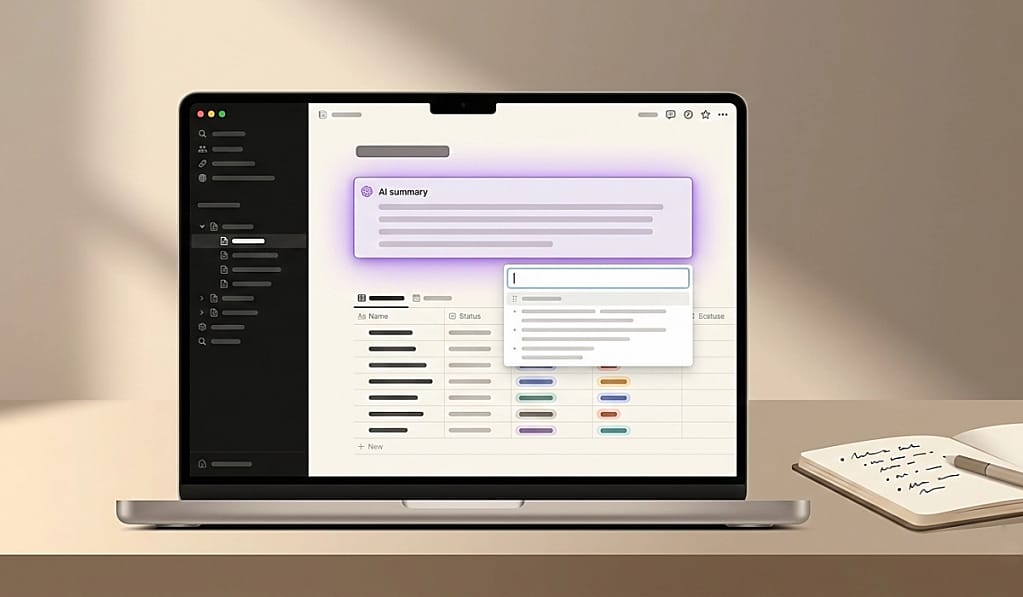
The complete guide to using Notion AI as a virtual assistant, features explained by VA use case, four high-impact Notion AI templates, and the workflows that eliminate the manual documentation and admin work that consumes the most hours in a VA operation.
Notion is already the workspace tool of choice for most virtual assistants who manage multiple clients, flexible enough to house client dashboards, SOPs, content calendars, and project trackers in a single system. Notion AI for virtual assistants extends that system from storage and organization into active assistance, it generates content, summarizes meetings, answers questions about your workspace, and populates database fields automatically.
The result is a workspace that does not just hold information, it processes it. A VA who would previously spend 20 minutes writing a meeting summary and populating the client dashboard with action items now spends 3 minutes reviewing what Notion AI produced. Applied to documentation, SOP creation, client reporting, content management, and onboarding, the compound time saving across a full client roster is substantial.
This guide covers how to use Notion AI as a virtual assistant, the features that produce the highest ROI for VA-specific work, the templates worth building first, and the workflows that reduce the documentation and admin overhead that every VA operation carries.
What this guide covers:
- What Notion AI does and which features matter most for VAs
- How to use Notion AI for the highest-frequency VA tasks
- Four Notion AI templates with advanced prompt libraries
- The Notion AI vs other AI tools comparison
- Five complete Notion AI workflows with implementation detail
- Limitations to understand before building your system
👉 Download the Free AI Starter Toolkit — includes Notion AI prompt templates ready to use immediately.
👉 AI Tools for Virtual Assistants: The Complete Practical Guide — the full reference for every AI tool category in VA work.
Table of Contents
1. What Notion AI Does and What It Does Not Do
Notion AI is an AI layer built directly into the Notion workspace, it operates on the pages, databases, and documents you already have, rather than as a separate tool you switch to. This integration is its primary advantage and the reason it is more useful for virtual assistants who use Notion as their operational hub than a standalone AI tool like Claude or ChatGPT used in a separate browser tab.
What Notion AI does well:
It generates, rewrites, summarizes, and structures text-based content inside your Notion pages. It populates database fields automatically (AI Autofill). It answers questions about the content in your workspace (Ask Notion). It processes meeting notes, research, and client updates into clean, structured output. It maintains consistency in tone and format across documents in the same workspace.
What Notion AI does not do:
It does not connect to external tools or trigger cross-platform automations, that requires Zapier or Make. It does not have memory of previous conversations outside your workspace. Its output quality depends entirely on the quality of the content already in your Notion pages, a sparse, disorganized workspace produces sparse, disorganized AI output. It is not a replacement for Claude or ChatGPT for open-ended reasoning or complex multi-step problem solving.
The practical implication for VAs:
Notion AI produces the most value when your Notion workspace is already organized and actively used. If your current Notion setup is a collection of half-populated pages and unused databases, the first investment is organizing the workspace, then activating Notion AI on top of it. The tool amplifies what is already there; it does not fix structural gaps.
Want to Start Using AI Tools the Right Way?
If you’re a Virtual Assistant and feel confused by too many AI tools, this free starter toolkit shows you exactly where to begin, without tech overwhelm.
2. The 5 Notion AI Features That Matter Most for VAs
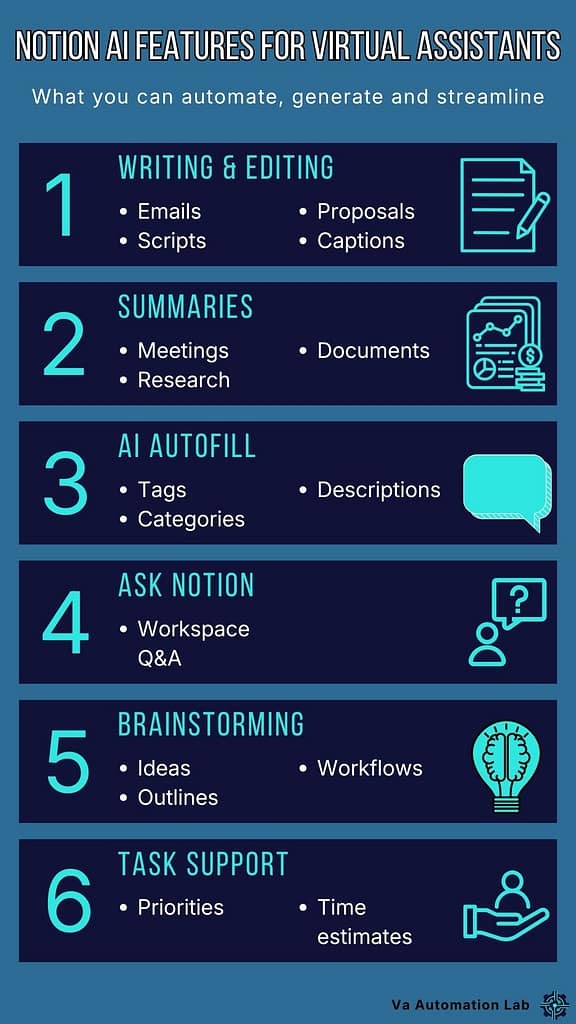
Not all Notion AI features produce equal value for virtual assistant workflows. The five below are the ones with the highest frequency-to-impact ratio for VA-specific operations, the features worth learning first before exploring the full capability set.
AI Writing & Editing
The most frequently used feature for VAs who handle client communication and documentation. Write faster, rewrite for clarity or tone, expand bullet notes into full paragraphs, or condense long drafts into concise versions, all inside the Notion page where the content already lives.
Highest-value VA applications:
- Drafting client-facing documents directly in Notion without switching to a separate AI tool
- Rewriting raw meeting notes into professional communication in seconds
- Standardizing tone across all pages in a client workspace, one command applied across the library
When to use it vs. Claude/ChatGPT: Use Notion AI writing for content that lives in Notion and benefits from workspace context. Use Claude or ChatGPT for content that requires extended reasoning, complex instructions, or information from outside the Notion workspace.
AI Summaries
The highest time-saving feature per use for most VAs. A 40-message meeting notes page becomes a structured 3-paragraph summary with action items in under 10 seconds.
Highest-value VA applications:
- Meeting notes → structured summary with decisions, action items, and next steps
- Long client research pages → executive brief
- Week’s activity across multiple pages → consolidated weekly status
Implementation note: Notion AI summaries work on the page they are applied to. For summaries that span multiple pages or databases, use the Ask Notion feature (below) instead.
AI Autofill in Databases
The most operationally powerful feature for VAs managing structured systems. AI Autofill adds an AI-generated column to any Notion database and populates it automatically based on each row’s existing content, no manual input required after initial configuration.
Highest-value VA applications:
- Task database: auto-generate task descriptions, priority levels, and category tags from task titles
- Content calendar: auto-generate post captions, content angles, or format recommendations from topic and audience fields
- Client CRM: auto-summarize recent activity per client from linked meeting notes
Implementation note: AI Autofill requires a prompt you configure once per database property. The prompt runs automatically on all new rows. For existing rows, run it in batch via “Fill all” in the property settings.
Ask Notion (Workspace Q&A)
The feature that transforms your Notion workspace from a storage system into a queryable knowledge base. Ask Notion in natural language and it searches across all pages and databases to generate a contextual answer.
Highest-value VA applications:
- “What tasks are overdue across all client projects?”
- “Summarize all updates for Client A from this month.”
- “What decisions were made in last week’s meetings?”
- “Which SOPs cover the invoicing process?”
Limitation: Ask Notion searches your workspace content, its quality depends on how completely and consistently that content is documented. A VA who logs all client activity in Notion gets accurate, comprehensive answers. A VA who only uses Notion for some clients gets partial answers that may miss critical information.
AI Brainstorming
The lowest-setup feature with immediate practical value for VAs who handle content creation, planning, or system design for clients. Open any Notion page, type a prompt, and receive a structured output (content ideas, SOP outlines, onboarding steps, project phases) that serves as the starting point for more refined work.
Highest-value VA applications:
- Content calendar: generating 4-week content plans from a client’s niche and audience description
- SOP creation: generating the structural outline before populating each step with specific details
- Client proposals: generating service options and deliverable descriptions from a brief
Feature | What It Does | Best VA Use Case |
AI Writing & Editing | Generates, rewrites, expands, condenses text | Client docs, communication, SOPs |
AI Summaries | Condenses pages into structured summaries | Meeting notes, research, weekly reviews |
AI Autofill | Auto-populates database columns with AI | Task management, content calendar, CRM |
Ask Notion | Answers questions about workspace content | Cross-client reviews, knowledge retrieval |
AI Brainstorming | Generates ideas and structured outlines | Content planning, system design |
3. How to Use Notion AI as a Virtual Assistant: Daily Task Applications
The five use cases below represent the highest-frequency applications of Notion AI for virtual assistants in daily operations. Each includes a concrete implementation note and a prompt in Code block format ready to copy into your Notion workspace.
Client Communication
Use Notion AI to draft, refine, and manage written communication directly inside the client’s Notion workspace, no context switching required.
Time saving benchmark: 10-15 minutes per email reduced to 2-3 minutes of review and editing.
Rewrite this email in a professional but warm tone.
Make it more concise, under 150 words.
Keep all key information and maintain a clear CTA at the end.

Email: [PASTE EMAIL DRAFT]
Draft a follow-up email to this client based on the notes below.
Reference the specific decisions made and the next action required from them.
Tone: professional and direct. Under 120 words.
Meeting notes: [PASTE NOTES]Meeting Notes & Summaries
The highest-ROI single use of Notion AI for most VAs. Paste raw notes into a Notion page immediately after a meeting, apply the summary prompt, and the structured output is ready in under 30 seconds.
Time saving benchmark: 15-20 minutes per meeting reduced to 3-5 minutes including review.
Summarize these meeting notes. Output:
- Date and attendees
- Main topics discussed (bullet list)
- Decisions made (bullet list)
- Action items: WHO does WHAT by WHEN
- Open questions or unresolved items
- Next meeting date if mentioned

Notes: [PASTE RAW NOTES]
Content Creation
For VAs managing social media, newsletters, or blog content, Notion AI operates inside the content calendar database, generating ideas, writing captions, and repurposing content without leaving the workspace.
Generate 10 social media post ideas for this client.
For each: topic, angle, format (carousel/reel/static), and a suggested hook.

Client niche: [NICHE]
Target audience: [AUDIENCE DESCRIPTION]
Current campaign focus: [FOCUS OR LEAVE BLANK]
Rewrite this caption in three variations:
1. Educational — focuses on a key insight
2. Storytelling — opens with a relatable scenario
3. Direct — short, punchy, clear CTA
Original: [PASTE CAPTION]
Brand tone: [TONE DESCRIPTION]For clients who include social media management in their service scope, the onboarding process should include the setup of the content calendar, brand voice guide, and Buffer channel configuration that the automation system requires. For the complete social media automation setup sequence, see How to Automate Social Media as a Virtual Assistant.
SOP Creation and Documentation
Turn messy notes, voice-to-text transcripts, or scattered process descriptions into clean, structured SOPs using Notion AI, without drafting from scratch.
Time saving benchmark: a 45-minute manual SOP writing session reduced to 10-15 minutes of AI-assisted drafting and editing.
Convert these notes into a complete SOP.
Structure:
1. Purpose (1 sentence)
2. When to use this SOP
3. Prerequisites (tools, access, information needed)
4. Step-by-step instructions (numbered, detailed)
5. Quality check (how to verify correct completion)
6. Troubleshooting (common issues and fixes)

Notes: [PASTE RAW NOTES OR PROCESS DESCRIPTION]
Task and Project Management
Use AI Autofill to eliminate the manual work of populating task databases, descriptions, priority levels, category tags, and time estimates generated automatically from task titles.
Configuration for AI Autofill on a tasks database: Add a new property → AI Autofill → configure with:
Based on this task title, generate:
- A 2-sentence description of what the task involves
- Priority: High / Medium / Low
- Estimated time: [X] minutes
- Category: Admin / Client Work / Content / Communication / Operations
Use Case | What Notion AI Does | Time Saving |
Client Communication | Drafts, rewrites, summarizes emails | 10-15 min/email |
Meeting Notes | Extracts tasks, decisions, next steps | 15-20 min/meeting |
Content Creation | Generates ideas, captions, plans | 60-90 min/week |
SOP Creation | Converts notes into structured SOPs | 30-40 min/SOP |
Task Management | Autofills categories, priorities, descriptions | 5-10 min/day |
4. Notion AI Templates for Virtual Assistants
The four templates below are the highest-impact starting points for any Notion AI for virtual assistants setup focused on client management. Each is designed as a reusable structure that works across clients with minimal modification, the goal is one setup, multiple clients.
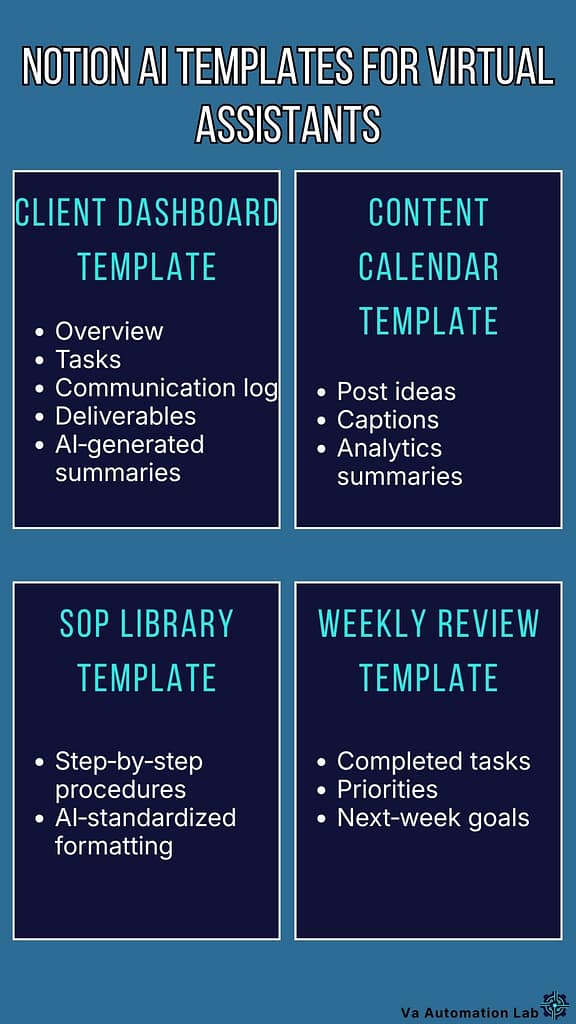
Template 1 — Client Dashboard
What it is: a centralized hub for managing each client’s information, ongoing work, and communication history in a single Notion page.
Structure:
- Client overview (name, service type, contracted hours, key contacts, tools used)
- Active projects with status and deadline
- Weekly priorities
- Communication log (linked to meeting notes database)
- Deliverables tracker
- Open questions and decisions pending
How to configure AI Autofill for this template:
On the Communication Log database, add an AI Autofill property with this prompt:
Summarize this meeting note entry in 2-3 sentences.
Include: main topic, key decision or outcome, and any action item assigned.
Advanced prompts for the Client Dashboard:
Summarize all updates from this client page and generate a structured weekly report including: key wins, blockers, pending tasks, and recommended next steps.Based on these notes, draft a concise follow-up email highlighting decisions made, upcoming
deadlines, and required actions from the client.
Tone: professional and warm. Under 150 words.Template 2 — Content Calendar
What it is: a database-driven content planning system where Notion AI generates ideas, writes captions, and assists with repurposing, without leaving the workspace.
Database structure:
- Post title / topic
- Platform (Instagram, LinkedIn, Newsletter, etc.)
- Format (carousel, reel, static, long-form)
- Status (Idea → Draft → Review → Scheduled → Published)
- Publish date
- AI-generated caption (AI Autofill property)
- Performance notes (filled post-publication)
AI Autofill configuration for Caption property:
Based on this post topic and platform, write a platform-appropriate caption with:
- A strong opening hook (first line)
- Core message (2-3 sentences)
- CTA (1 sentence)
Tone: [CLIENT TONE — update per client]
Advanced prompts:
Generate a 4-week content plan for this client.
For each post include: topic, angle, format, platform, and a one-sentence caption hook.

Client niche: [NICHE]
Audience: [DESCRIPTION]
Monthly theme or campaign: [THEME]
Posting frequency: [X] times per week
Repurpose this long-form content into 5 short social media posts.
For each: platform, format, hook, core message, and CTA. Adapt tone and length for each platform.
Original content: [PASTE]
Platforms: [LIST]Template 3 — SOP Library
What it is: a structured repository for all repeatable processes, both internal VA operations and client-specific workflows, with consistent formatting enforced by Notion AI.
Database structure:
- SOP title
- Category (Client Onboarding / Reporting / Content / Admin / Communication)
- Client (linked to client database or “Internal”)
- Last updated date
- Status (Draft / Active / Archived)
- AI-generated summary (AI Autofill property)
AI Autofill configuration for Summary property:
Summarize this SOP in 2 sentences.
Include: what process it covers and when to use it.
Advanced prompts:
Convert these notes into a complete SOP.
Structure: Purpose | When to use | Prerequisites | Step-by-step instructions (numbered) |
Quality check | Troubleshooting.
Fill in missing steps based on the context provided.

Notes: [PASTE]
Rewrite this SOP using the same structure, tone, and formatting as the other SOPs in this library.
Ensure consistency across all sections. Do not change the substance, only standardize the presentation.
SOP to rewrite: [PASTE]
Reference SOP for style: [PASTE]Template 4 — Weekly Review System
What it is: a recurring page template for weekly reflection, planning, and client status consolidation, the operational foundation of consistent VA delivery.
Page structure:
- Week number and date range
- Completed this week (per client)
- In progress (per client)
- Blockers or unresolved items
- Priorities for next week
- Admin and internal tasks
- Notes and observations
How to use Notion AI on this template:
After populating the completed and in-progress sections manually (5-10 minutes), use Notion AI to generate the planning and reporting sections:
Based on this week's completed tasks and in-progress items, generate:
1. Top 3 priorities for next week per client
2. Any risks or blockers to address
3. A one-paragraph summary I can use as a status update in my internal planning document.
Summarize all completed tasks from this week and categorize them by: client, task type (admin / deliverable / communication / research), and estimated impact (high / medium / low).Template | Primary Use | AI Features Used | Time to Build | Start Here If… |
Client Dashboard | Client management, reporting, communication log | AI Autofill + Summaries | 45 min | You manage 2+ active clients |
Content Calendar | Social media, newsletter, content production | AI Autofill + Brainstorming | 30 min | You handle content for clients |
SOP Library | Process documentation, repeatable workflows | AI Writing + AI Autofill | 20 min | You need standardized operations |
Weekly Review | Planning, status consolidation, priorities | AI Summaries + Ask Notion | 15 min | You want a structured weekly rhythm |
5. Notion AI vs Other AI Tools
Understanding where Notion AI fits in the VA tool stack prevents the most common mistake: using it for everything, or using it for nothing because other tools seem more capable in isolated comparisons.
Feature | Notion AI | ChatGPT | Jasper | ClickUp AI |
Integrated in workspace | ✅ | ❌ | ❌ | ✅ |
Database automation | ✅ | ❌ | ❌ | ✅ |
Writing tools | ✅ | ✅ | ✅ | ✅ |
Summaries | ✅ | ✅ | ✅ | ✅ |
Workspace Q&A | ✅ | ❌ | ❌ | ❌ |
Complex reasoning | ⚠️ Limited | ✅ | ❌ | ❌ |
Best for VAs | Workflow + documentation | Content + reasoning | Marketing copy | Task management |
The practical decision framework:
Use Notion AI when the content lives in Notion and benefits from workspace context, meeting summaries, SOP generation, database population, client dashboard updates, content calendar management. The zero-switching-cost advantage is real: opening Claude in a separate tab to summarize notes you could summarize with a single Notion AI command is pure friction.
Use Claude or ChatGPT when the task requires extended reasoning, information from outside the workspace, or a back-and-forth conversation to refine the output. Complex client proposals, strategic recommendations, troubleshooting workflows, and nuanced communication where multiple iterations are expected, these belong in Claude or ChatGPT.
Use ClickUp AI when your primary project management system is ClickUp rather than Notion. The two workspace AIs are analogous in function, choose based on where your operational data lives, not on feature comparisons.
The recommended combination for most VAs: Notion AI as the operational hub for documentation, databases, and workspace-native content + Claude as the reasoning and generation tool for complex or context-heavy tasks. These two tools cover 95% of VA AI needs without overlap.
👉 How to Start Using AI as a Virtual Assistant — the beginner framework for building this tool combination.
👉 ChatGPT for Virtual Assistants: Complete Guide — for the complete ChatGPT use case breakdown and prompt library for VA operations.
The decision between Notion and ClickUp as your primary workspace tool is separate from the question of which AI features each platform offers, and it is the more consequential decision for your daily operational structure. For the complete side-by-side comparison across eight feature categories, the automation gap analysis, and the VA profile decision framework 👉 Notion vs ClickUp for Virtual Assistants: Complete Comparison Guide.
6. Five Notion AI Workflows — With Implementation Detail
The five workflows below show how to use Notion AI for virtual assistants at the implementation level, not as a list of features, but as repeatable sequences that handle specific, high-frequency VA tasks from input to finished output. Each workflow documents the exact steps, the prompt to use at each stage, and the time saving benchmark so you can evaluate the ROI before building it.
Taken together, these Notion AI workflows cover the core operational cycle of most VA businesses: client reporting, onboarding, documentation, content production, and relationship management. The recommended sequence is to implement them in order, Workflow 1 produces visible results in the first week and establishes the documentation habit that makes every subsequent workflow more effective.
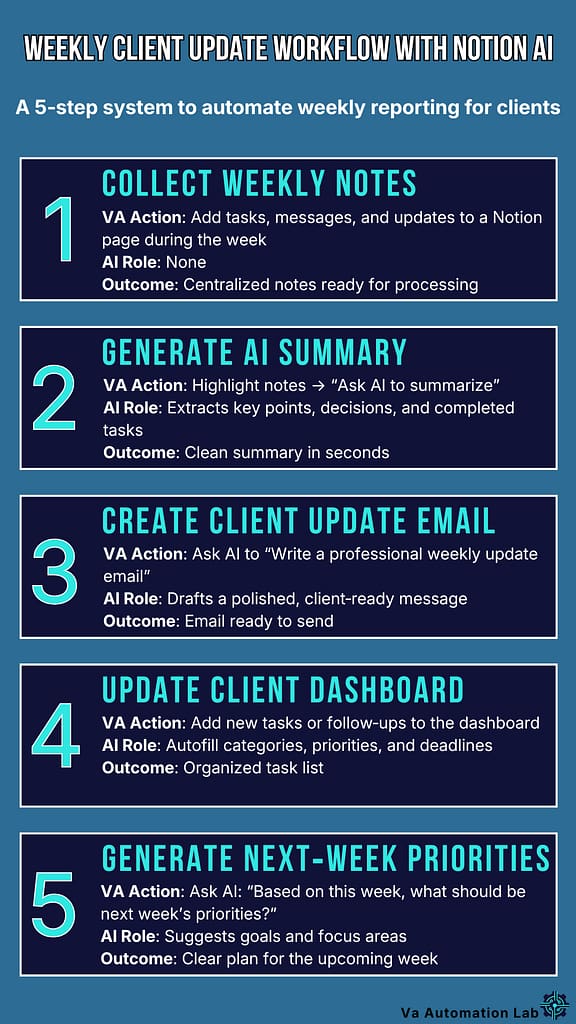
Workflow 1 — Weekly Client Update
What it does: converts a week’s worth of Notion activity (completed tasks, meeting notes, client updates) into a polished, professional client status email in under 5 minutes.
Time to implement: 20 minutes to set up the template. 5 minutes per client per week to run.
Step-by-step:
- At the end of each week, open the client’s Notion dashboard page. Verify the current week’s tasks, meeting notes, and updates are logged.
- Open a new Notion page or the Weekly Review template. Paste or link the week’s relevant content.
- Apply Notion AI with this prompt:
Summarize this week's client activity and generate a structured status update email including:
- Subject line
- Opening sentence (brief positive framing)
- Key accomplishments this week (bullet list, max 5)
- In progress (bullet list, max 3)
- Coming up next week (bullet list, max 3)
- Any items requiring client input or decision
- Closing line with next scheduled touchpoint

Tone: professional and warm. Total length: under 200 words.- Review output, verify facts against the source content, adjust tone for the specific client relationship, add any context Notion AI missed.
- Send from the client’s email account or your VA account depending on the engagement type.
Result: consistent, professional weekly updates delivered to every client without spending 20-30 minutes per client writing them manually.
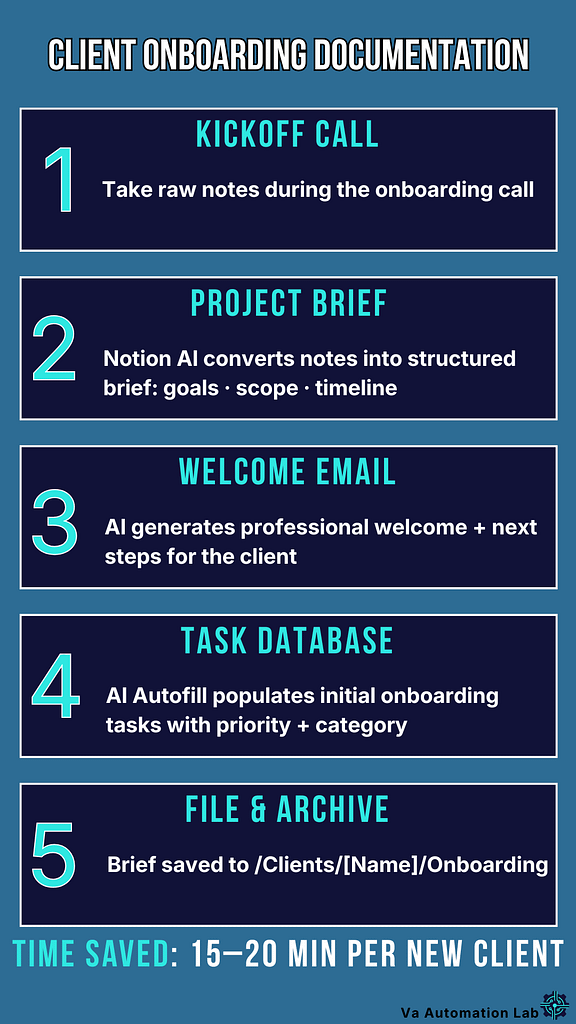
Workflow 2 — Client Onboarding Documentation
What it does: transforms a new client intake form or kickoff call notes into a complete onboarding package (welcome email, project brief, SOP checklist, and client dashboard setup) using Notion AI.
Time to implement: 30 minutes to configure the onboarding template. 15-20 minutes per new client.
Step-by-step:
- After the onboarding call, paste raw notes into the client’s Notion workspace.
- Apply Notion AI to generate the project brief:
Convert these onboarding notes into a structured project brief including:
- Client overview (name, business, service purchased)
- Primary goals (what success looks like for them)
- Key contacts and communication preferences
- Tools and platforms to manage
- Contracted deliverables and scope
- Timeline and key dates
- Open questions to resolve before starting

Notes: [PASTE ONBOARDING NOTES]- Generate the welcome email:
Write a professional welcome email for a new client.
Include: confirmation of the engagement start, brief summary of the agreed scope, next steps
they need to complete (list max 3), and scheduled first check-in date.

Client name: [NAME]
Service: [SERVICE DESCRIPTION]
Start date: [DATE]
Next steps for client: [LIST FROM BRIEF]
Tone: warm and professional.- Use AI Autofill to populate the client’s task database with the initial onboarding task list generated from the project brief.
- File the completed brief in the client’s Notion workspace under /Clients/[Name]/Onboarding.
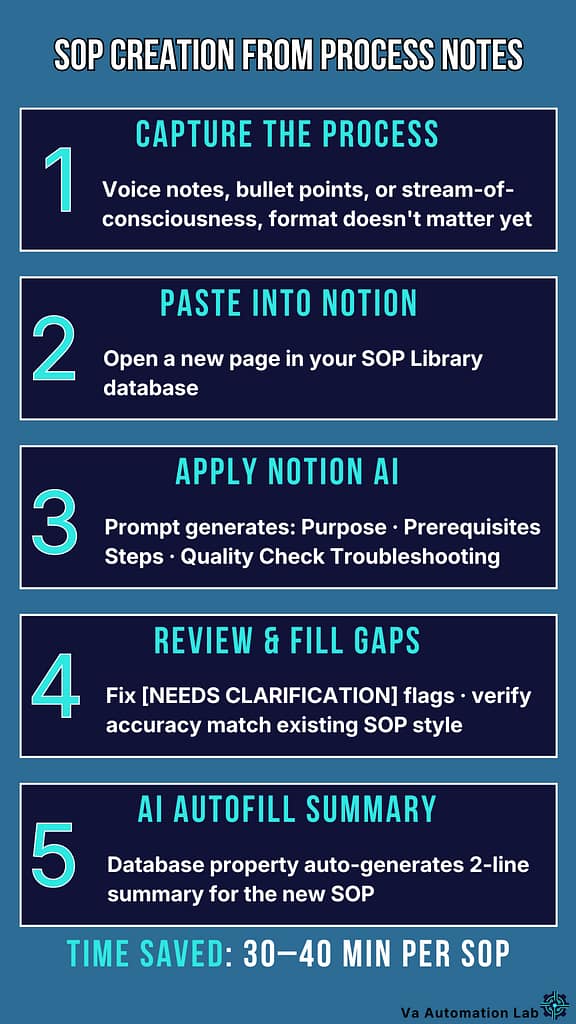
Workflow 3 — SOP Creation from Process Notes
What it does: turns unstructured process descriptions (voice-to-text dumps, bullet notes, or scattered instructions) into complete, consistently formatted SOPs in under 15 minutes.
Step-by-step:
- Document the process as you execute it, voice notes, bullet points, or stream-of consciousness text. Accuracy of content matters; formatting does not at this stage.
- Paste the raw notes into a new Notion page in your SOP Library.
- Apply Notion AI:
Convert these process notes into a complete SOP.

Structure:
1. Title: [one line, action-oriented]
2. Purpose: what this process accomplishes (1-2 sentences)
3. When to use: trigger conditions
4. Prerequisites: tools, access, information needed before starting
5. Steps: numbered, detailed, one action per step
6. Quality check: how to verify correct completion
7. Troubleshooting: the 2-3 most common issues and their fixes

Fill in gaps based on the context provided.
If information is missing, note it with [NEEDS CLARIFICATION].

Raw notes: [PASTE]- Review the output, fill in any [NEEDS CLARIFICATION] flags, verify technical accuracy, adjust to match the formatting of existing SOPs in your library.
- AI Autofill auto-generates the summary property for the new SOP row in the database.
Workflow 4 — Content Production Pipeline
What it does: manages the full content production cycle for a client inside Notion, from ideation to caption drafting to post-publication performance review, using Notion AI at each stage.
Step-by-step:
- Monthly planning session (30 minutes): Open the content calendar database. Use Notion AI to generate the month’s content plan:
Generate a 4-week content plan for this client.

For each post:
- Topic
- Angle (what perspective or insight to take)
- Format (carousel / reel / static / story)
- Platform
- One-sentence hook

Client niche: [NICHE]
Audience: [DESCRIPTION]
Monthly focus: [THEME OR CAMPAIGN]
Frequency: [X posts/week]- Weekly production (15-20 minutes per client): For each post in the current week’s queue, use AI Autofill to generate the draft caption from the topic and angle fields.
- Review and edit captions, 2-3 minutes per post. Adjust for brand voice nuances that the AI consistently misses and note them in the client’s AI preferences section.
- Post-publication: add performance data to the database. Monthly, use Ask Notion to generate the performance review:
Analyze this month's content performance data and generate a brief report including:
- Top performing post (and why it likely worked)
- Lowest performing post (and what to adjust)
- Patterns across the month
- Three recommendations for next month
Workflow 5 — Notion for Client Management: CRM and Relationship Intelligence
What it does: maintains a lightweight CRM inside Notion where AI Autofill and Ask Notion generate ongoing client intelligence, relationship summaries, follow-up identification, and monthly status reports.
Database structure:
Build a Clients database with properties:
- Client name, service tier, status (Active/Paused/Closed)
- Contracted hours per month
- Primary contact and communication preference
- Last contact date (auto-updated)
- Linked pages: meeting notes, deliverables, invoices
- AI summary property (AI Autofill)
AI Autofill configuration:
Summarize this client's current status based on linked pages. Include:
- Active projects and their status
- Last interaction and outcome
- Any pending items or unresolved questions
- Overall relationship health: On Track / Attention Needed
Weekly Ask Notion queries for client management:
Which clients have had no communication logged in the past 7 days?Summarize all pending action items across all active clients. Group by client and due date.Which clients have deliverables due this week?
List by client with the specific deliverable and deadline.Monthly client intelligence report:
Generate a monthly summary for [CLIENT NAME].
Include: key accomplishments, ongoing projects, relationship notes, risks or concerns, and recommended next steps for the coming month.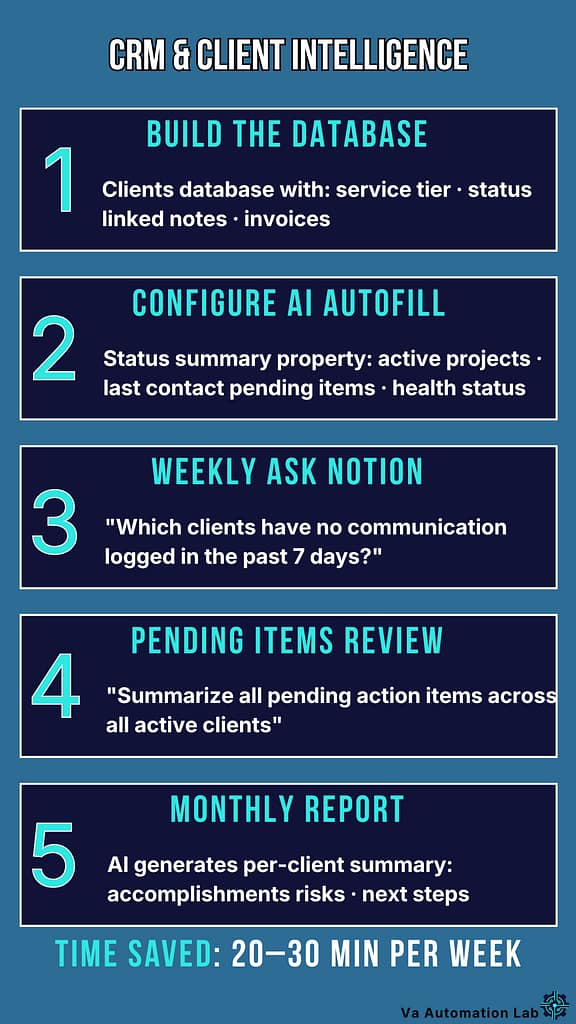
👉 AI Email Management for Virtual Assistants — connecting Notion AI workflows to email management.
👉 How to Automate Repetitive Tasks as a Virtual Assistant — extending Notion AI into full no-code automation workflows.
👉 Best Automation Workflows for Virtual Assistants — the complete automation workflow library.
7. Limitations of Notion AI
Understanding the limitations of Notion AI for virtual assistants prevents over-reliance and clarifies when to use a different tool.
Output Quality Depends on Workspace Quality
Notion AI generates output based on what is in your workspace. If meeting notes are incomplete, client pages are sparsely populated, or databases have missing fields, the AI output reflects those gaps, incomplete summaries, generic descriptions, inaccurate status reports. Notion AI is not a substitute for disciplined documentation practice; it is an accelerator for VAs who already document consistently.
No Cross-Platform Memory or Integration
Notion AI cannot retrieve information from Gmail, ClickUp, Slack, or any external tool. It operates entirely within the Notion workspace. A meeting that was not logged in Notion does not exist for Notion AI. For VAs who manage client operations across multiple platforms, this means either centralizing key information in Notion as a deliberate practice or accepting that Ask Notion queries will return incomplete results.
Not Optimized for Complex Reasoning
Notion AI performs well on structured, predictable tasks, summarization, formatting, categorization, first-draft generation. It underperforms Claude and ChatGPT on tasks that require extended reasoning, nuanced judgment, or multi-step problem solving. For complex client proposals, strategic planning, or situations with significant ambiguity, use Claude or ChatGPT and paste the output into Notion rather than generating it in Notion directly.
Pricing Model
Notion AI is an add-on to Notion subscriptions, currently priced at $10/user/month on top of the base Notion plan. For a VA managing multiple client workspaces as a guest in those workspaces, the cost structure depends on whether the client’s Notion plan includes AI access. Verify before building Notion AI workflows into a client’s workspace that the client’s plan supports it, or confirm who absorbs the AI add-on cost.
Before building Notion AI workflows, verify:
✅ Notion workspace is actively used and documented
✅ Key client information is logged in Notion consistently
✅ Client’s Notion plan includes AI add-on (if working in their workspace)
✅ Complex reasoning tasks routed to Claude / ChatGPT, not Notion AI
✅ Budget accounts for $10/month AI add-on per user
8. Conclusion
Notion AI for virtual assistants produces the most value when it is treated as an accelerator for work that already has a clear structure, not as a tool that creates structure from nothing.
The practical starting sequence: configure the client dashboard template with AI Autofill for the communication log summary property. Run the weekly update workflow for one client for two weeks. Add the SOP creation workflow when the next process needs documentation. Expand to the content production pipeline for clients where content management is part of the scope.
Each addition builds on the previous one. This is how Notion AI for virtual assistants operates at its most effective, not as a feature demonstration, but as a compounding operational system. Within a month of consistent use, the documentation and reporting overhead that every VA operation carries, the 30-40 minutes per client per week spent writing summaries, drafting updates, and maintaining records, compresses into a review and edit task that takes a fraction of the time.
That recovered time is the measurable output of using Notion AI as a virtual assistant at the operational level, not the feature demonstration level.
Frequently Asked Questions About Notion AI for Virtual Assistants
Is Notion AI worth it for virtual assistants?
For VAs who already use Notion as their primary workspace, Notion AI for virtual assistants is worth the $10/month add-on cost if it eliminates at least 30 minutes of weekly documentation or writing work, which most VAs reach within the first week of consistent use on
meeting summaries alone.
For VAs who do not currently use Notion as an operational hub, the investment calculus is different: the Notion AI add-on value depends entirely on how much of the VA’s work already lives in Notion. Building a Notion workspace first, stabilizing it, and then activating Notion AI produces better results than starting both simultaneously.
What is the difference between Notion AI and ChatGPT for virtual assistants?
The primary difference is context and integration. Notion AI operates inside your workspace, it can access, summarize, and populate your existing pages and databases without copy-pasting.
ChatGPT (and Claude) are external tools where you bring the context manually. For workspace-native tasks (meeting summaries, SOP generation, database population, client dashboard updates), Notion AI is faster because it has zero switching cost.
For complex reasoning, extended conversations, or content generation that requires information from outside Notion, Claude or ChatGPT produces better output.
Most VAs use both, Notion AI for operational content, Claude/ChatGPT for complex or external-context tasks.
How do I set up AI Autofill in Notion?
Open any Notion database → add a new property → select “AI Autofill” from the property type list. Write a prompt that describes what you want the property to generate based on the other fields in that database row. Save the property.
For new rows, the AI Autofill property populates automatically. For existing rows, click the property → “Fill all” to run the prompt across all existing entries. The prompt is editable at any time, update it to refine the output quality as you understand what the AI produces consistently versus where it needs more guidance.
Can I use Notion AI to manage multiple client
workspaces?
Yes, with two approaches. If clients have shared their Notion workspace with you as a guest, you can use Notion AI directly in their workspace (subject to their plan including AI). If you manage client work in your own Notion workspace rather than theirs, build a separate database or section per client with its own AI Autofill configuration and linked meeting notes.
The second approach gives you more control over the AI configuration but requires that all client information be logged in your Notion rather than the client’s.
What are the best Notion AI prompts for virtual assistants?
The highest-impact prompts for VA operations are specific about structure and output format.
The five most consistently useful:
(1) Meeting summary with action items extracted by WHO/WHAT/WHEN.
(2) Weekly client status email under 200 words with accomplishments, in-progress, and next steps.
(3) SOP generation with the full structure (purpose, prerequisites, steps, quality check,
troubleshooting) from raw notes.
(4) AI Autofill prompt for task databases that generates description, priority, and category from the task title.
(5) Ask Notion query for pending action items across all active client pages. All five are documented with full prompt text in the workflow sections of this guide.
Does Notion AI work without an internet connection?
No, Notion AI requires an active internet connection to process requests. This is consistent with all cloud-based AI tools. If you work in environments with unreliable connectivity, build your workflow to complete the manual documentation step (raw notes input) offline when necessary, then run the Notion AI processing steps when connectivity is restored.
Ready to Build a Smarter, AI‑Powered VA Business?
Get the free AI Starter Toolkit and learn how to use simple AI tools and workflows to save time and deliver more value to your clients.
Glossary: Key Notion and Notion AI Terms for Virtual Assistants
Notion AI The AI assistant integrated directly into the Notion workspace, generates content, summarizes pages, populates database fields, and answers questions about workspace content without requiring a separate tool.
AI Autofill A Notion database property type that uses a configured prompt to automatically generate content for each row based on existing field values.
Ask Notion A Notion AI feature that allows natural language queries across the entire workspace, searching pages and databases to return contextual answers.
Notion Database A structured table in Notion where each row is a page with its own properties (fields). Used for task management, content calendars, CRMs, and SOP libraries in VA workflows.
Notion AI Workflow A repeatable sequence of Notion AI operations applied to a specific VA task, from collecting raw input to generating structured output, with defined prompts for each step.
SOP (Standard Operating Procedure) A documented, step-by-step process for a recurring task, one of the primary use cases for Notion AI generation and the core content of an SOP Library.
AI Prompt The instruction given to Notion AI that determines what it generates. Prompt quality directly determines output quality, specific, structured prompts produce specific, structured outputs.
Client Dashboard A Notion page or database that centralizes all information for a specific client (projects, communication history, deliverables, and notes) enhanced by Notion AI summaries and Autofill.
Knowledge Base A structured Notion workspace section containing documented processes, FAQs, templates, and reference materials, queryable via Ask Notion.
Workspace Context The content already in your Notion workspace that Notion AI uses to generate relevant, specific output. The quality of AI-generated summaries and answers depends directly on how completely the workspace is documented.
About the Author
Alex Stratton has spent the better part of a decade working at the intersection of virtual assistance and operational systems, first as a VA supporting founders and small business owners, then as a workflow consultant helping remote teams reduce the manual overhead that accumulates when businesses grow faster than their processes. The tools and workflows here reflect decisions made repeatedly in real client contexts, where the wrong choice costs hours, not minutes. Learn more about VA Automation Lab → About.