
ChatGPT for Virtual Assistants: Complete Guide to Use Cases, Prompts & Workflows (2026)
The complete guide to using ChatGPT as a virtual assistant: the ten highest-impact use cases organized by task category, 20+ ready-to-use prompt templates, the ChatGPT virtual assistant workflows that reduce admin time by 60-80%, the plans comparison for VA operations, and the implementation sequence that gets you from zero to a fully integrated ChatGPT workflow in five days.
ChatGPT for virtual assistants is the most widely adopted AI tool in 2026, not because it is the most technically sophisticated option available, but because it is the most immediately usable. A VA who opens ChatGPT for the first time can produce a professional client email draft in under two minutes, with no training, no configuration, and no technical background required. That accessibility is its primary advantage, and the reason it remains the default starting point for VAs who are learning how to use ChatGPT as a virtual assistant.
But accessibility and systematic operational use are different things. Most VAs who use ChatGPT regularly are using approximately 20-30% of its potential in their daily operations, drafting emails when prompted to, generating occasional social media content, asking ad-hoc questions when stuck. The remaining 70-80% of ChatGPT’s value in VA operations comes from structured, repeatable use: a prompt library organized by task category, consistent prompt architecture that produces reliable outputs, and ChatGPT virtual assistant workflows that connect AI-generated content to the tools and processes already in use.
This guide covers the full operational picture, not just what ChatGPT can do for virtual assistants, but how to build a systematic, repeatable use that compounds over time.
What this guide covers:
- The ten best ChatGPT use cases for virtual assistants, organized by task category and operational impact
- 20+ prompt templates you can copy and use immediately, structured for VA-specific tasks
- ChatGPT plans comparison for VA operations, which plan is worth it and when
- Four ChatGPT virtual assistant workflows, from inbox management to client reporting
- Common prompting mistakes and how to fix them
- Implementation sequence, from first prompt to full ChatGPT integration in five days
Already managing clients with AI tools? Start with the prompt library in section 5 and skip straight to the workflows in section 10.
New to AI as a VA? Begin here:
Includes the core ChatGPT prompt library for VA operations.
Already using AI? See the complete tool stack → AI Tools for Virtual Assistants: The Complete Practical Guide
Table of Contents
1. What ChatGPT Is and What It Is Not
Understanding how to use ChatGPT as a virtual assistant effectively starts with a precise definition of what it is, and where its boundaries are. Conflating the two is the primary reason VAs either underuse it (treating it as a novelty rather than an operational tool) or overuse it (relying on its outputs without judgment, producing errors that damage client trust).
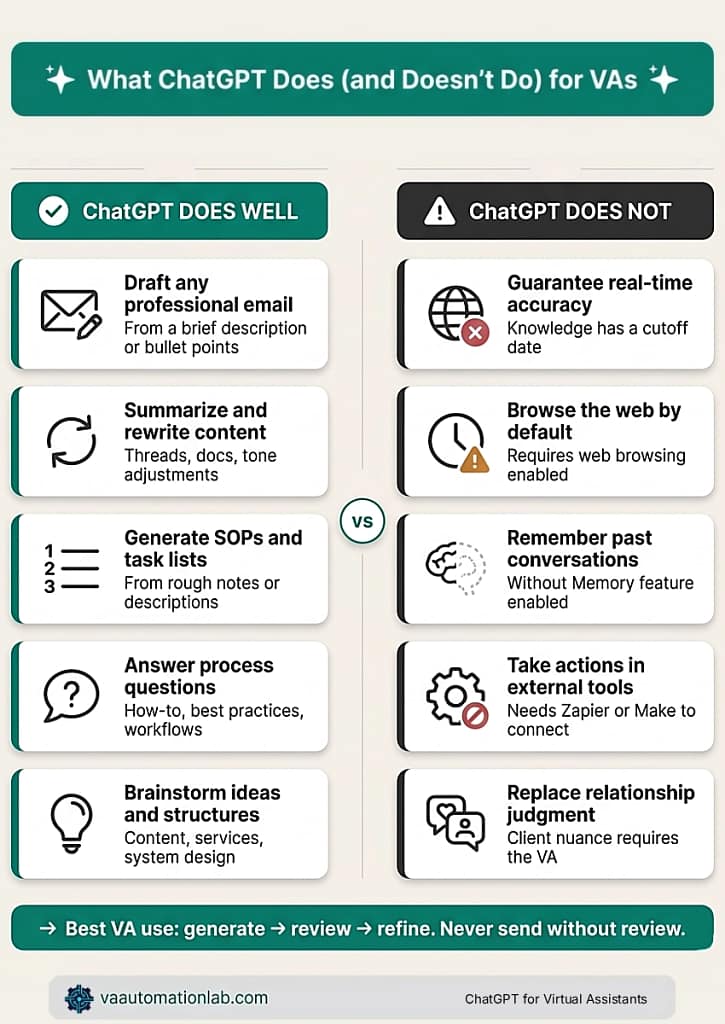
ChatGPT is a large language model built by OpenAI. In practical terms for VA operations, it is a text generation and transformation system, it takes input text (your prompt) and produces output text (a draft, a summary, a plan, a structured list) based on patterns in its training data and the instructions in your prompt. It does not browse the web in real time by default (web browsing is a separate feature available in paid plans), does not have memory of previous conversations by default (Memory is a feature you enable), and does not take actions in external systems on its own (that requires integration with automation tools like Zapier or Make).
What ChatGPT does exceptionally well for virtual assistants:
- Drafting any form of written communication (emails, reports, updates, proposals) from a brief description or bullet points
- Transforming existing text (summarizing, rewriting, reformatting, translating, adjusting tone)
- Generating structured outputs (task lists, SOPs, checklists, agendas, templates, frameworks)
- Answering process questions (“What should a client onboarding email include?” “What are the steps to set up a ClickUp dashboard?”)
- Brainstorming and ideation (content ideas, service expansion, workflow improvements)
What ChatGPT does not do reliably:
- Provide accurate real-time information without web browsing enabled
- Guarantee factual accuracy on specific numbers, dates, or recent events
- Replace human judgment on relationship context, client-specific nuance, or strategic decisions
- Take actions in external tools without automation integration
For a VA, the operative principle is simple: ChatGPT handles the generation and transformation of text. You handle the judgment, the context, and the relationship. The combination of the two, not either one alone, is where the operational advantage lies.
2. Why ChatGPT Is the Default Starting Point for Virtual Assistants
Of the AI tools available in 2026, ChatGPT for virtual assistants is not the most powerful for every specific task (Claude handles complex structured reasoning with more precision; Notion AI integrates more tightly with the Notion workspace; ClickUp AI is more native to task management). But it is the most strategically correct starting point for a VA building their AI capability from zero, for three reasons.
Reason 1 — Zero configuration required. ChatGPT produces useful output on the first prompt, with no workspace setup, no template library, no integration required. A VA who wants to draft a client update email can do so in 90 seconds from account creation to finished draft. No other AI tool in the VA stack has this combination of immediacy and output quality.
Reason 2 — The broadest task surface. ChatGPT handles every text-based task in a VA’s operational range: email drafting, SOP creation, report writing, meeting summaries, research synthesis, content creation, task breakdown, client proposals, social media copy, and more. Building proficiency with a single tool that covers the full task surface is more efficient than building proficiency with five specialized tools simultaneously.
Reason 3 — The most transferable prompt skills. The prompting principles that make ChatGPT outputs reliable and high-quality transfer directly to every other AI tool in the VA stack: Claude, Notion AI, ClickUp AI, and any AI integration in Zapier or Make. A VA who learns to write clear, structured prompts in ChatGPT is already equipped to use every AI tool they will encounter in their career.
This does not mean ChatGPT is the only tool a VA needs, it means it is the one that should be mastered first, before adding specialized tools for specific functions.
👉 How to Start Using AI as a Virtual Assistant — the beginner guide to the complete AI tool stack for VAs.
3. ChatGPT Plans for Virtual Assistants — Which One Do You Actually Need?
The plan question is one of the most common practical questions among VAs adopting ChatGPT for virtual assistants. The short answer for most VAs in 2026: start with Free, upgrade to Plus when you hit message limits or need web browsing for client research, and evaluate Business only if you are managing a team of VAs or have strict data privacy requirements.
Plan | Price | Best For | Key VA Features | Limitation |
Free | $0/mo | First month of exploration | GPT-4o (limited), basic prompting | Message limits, no web browsing, no Memory |
Plus | $20/mo | Solo VA — daily operational use | GPT-4o unlimited, web browsing, Memory, Custom GPTs, image generation | No team management |
Pro | $200/mo | High-volume or specialized work | Extended Thinking, higher limits, priority access | Overkill for most VA operations |
Business/Team | $25-30/user/mo | VA teams, agencies | Team workspace, admin controls, data not used for training | Requires multiple seats |
The right plan depends entirely on how you intend to integrate ChatGPT for virtual assistants into your daily operations, occasional use justifies Free, daily operational use justifies Plus immediately.
The Plus plan at $20/month is the operational threshold for VAs using ChatGPT as a daily work tool.
Three features justify the upgrade immediately:
Web Browsing — ChatGPT can research current information, check competitor content, verify facts, and pull recent data for client reports. Without web browsing, ChatGPT’s knowledge has a cutoff date, useful for process and writing tasks, unreliable for research that requires current information.
Memory — ChatGPT remembers your preferences, tone of voice guidelines, client names and context, and workflow preferences across sessions. Without Memory, every new conversation starts from zero, you re-explain the context every time. With Memory configured correctly, ChatGPT behaves like a briefed assistant rather than a first-time encounter.
Custom GPTs — pre-configured AI assistants you build for specific recurring tasks. A “Client Email Drafting GPT” that already knows your tone guidelines, your client roster, and your communication standards produces better outputs than a generic ChatGPT prompt every time.
The Free plan is appropriate for:
- Testing ChatGPT for the first time
- Occasional use (less than 5-10 prompts per day)
- VAs who already use another primary AI tool (Claude, Notion AI) and want ChatGPT for overflow tasks
The Plus plan is appropriate for:
- VAs using ChatGPT as their primary daily AI tool
- Any VA who needs web browsing for client research tasks
- VAs who want to build Custom GPTs for recurring task types
4. The Ten Best ChatGPT Use Cases for Virtual Assistants
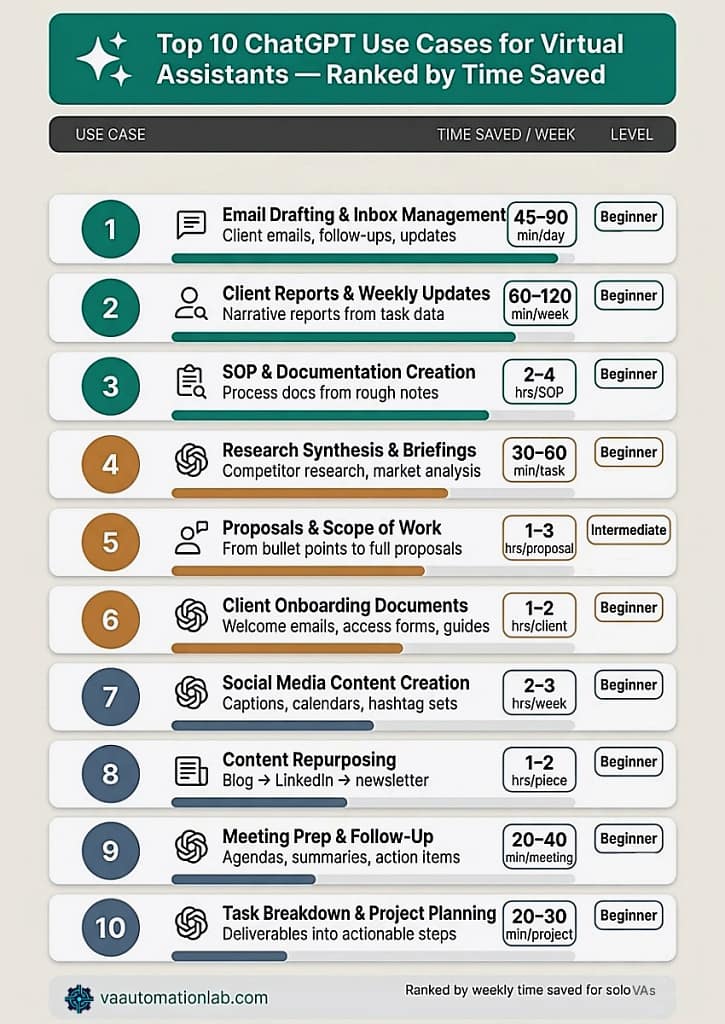
The best ChatGPT use cases for virtual assistants are organized below by task category and ranked by combination of time saved per week and quality uplift in the deliverable produced. Each use case maps to a specific task category in VA operations and connects to the prompt templates in section 5.
Use Case 1 — Email Drafting and Inbox Management
Time saved: 45-90 minutes/day
Difficulty: Beginner
Email is the highest-volume text task in most VA operations. ChatGPT eliminates blank-page drafting entirely, every email, follow-up, update, reminder, and proposal starts as an AI draft reviewed and refined by the VA, not written from scratch.
The operational shift is from write → review to generate → review → refine. The time saving is 60-75% per email for experienced ChatGPT users.
Use Case 2 — Client Reports and Weekly Updates
Time saved: 60-120 minutes/week
Difficulty: Beginner
Weekly updates and monthly reports are high-value deliverables for client retention but high-effort to produce manually. ChatGPT transforms completed task lists, metrics data, and project notes into professionally formatted, narrative reports in minutes.
Combined with Make automation (see section 10), this becomes a fully automated pipeline where ChatGPT writes the report and automation delivers it.
Use Case 3 — SOP and Documentation Creation
Time saved: 2-4 hours per SOP
Difficulty: Beginner-Intermediate
Standard Operating Procedures are the operational documentation layer that makes VA services scalable and consistent. They are also the most time-consuming document type to create manually. ChatGPT generates complete, structured SOPs from a brief description of the process in minutes, the VA reviews, refines, and approves.
Use Case 4 — Research Synthesis and Briefings
Time saved: 30-60 minutes per research task
Difficulty: Beginner
VAs regularly conduct research for clients: competitor analysis, industry trends, tool comparisons, supplier research, content research. ChatGPT (with web browsing enabled) synthesizes multiple sources into structured briefings, comparison tables, and executive summaries, eliminating the manual reading and reorganization that makes research tasks time-consuming.
Use Case 5 — Proposal and Scope of Work Writing
Time saved: 1-3 hours per proposal
Difficulty: Intermediate
Client proposals and Scopes of Work are high-stakes documents where quality directly affects close rate. ChatGPT generates professional proposal structures, service descriptions, pricing rationale paragraphs, and terms sections from bullet-point inputs, reducing a 2-3 hour writing task to a 20-30 minute review and refinement.
Use Case 6 — Onboarding Documentation and Templates
Time saved: 1-2 hours per new client
Difficulty: Beginner-Intermediate
Every new client requires the same set of onboarding documents: welcome email, services overview, access request form, onboarding questionnaire, first-week schedule. ChatGPT generates all of these from the client brief, replacing the manual assembly of documents from scratch each time.
Use Case 7 — Social Media Content Creation
Time saved: 2-3 hours/week
Difficulty: Beginner
Social media content creation is one of the most common service offerings for VAs and one of the most repetitive. ChatGPT generates captions, post copy, content calendars, hashtag sets, and engagement responses at scale, consistently, in the client’s brand voice when prompted correctly.
The social media content generation use case becomes significantly more powerful when ChatGPT is integrated into a systematic workflow, connected to a Notion content calendar, a client approval system, and a Buffer scheduling pipeline via Make. For the complete integrated system with prompt library and automation scenarios, see How to Automate Social Media as a Virtual Assistant.
Use Case 8 — Content Repurposing
Time saved: 1-2 hours per repurposing task
Difficulty: Beginner
Turning a blog post into LinkedIn content, a podcast transcript into a newsletter, a webinar into a series of social posts, content repurposing is high-value work for content-focused clients and highly automatable with ChatGPT. The input is existing content; the output is reformatted, tone-adjusted variants ready for each platform.
Use Case 9 — Meeting Preparation and Follow-Up
Time saved: 20-40 minutes per meeting
Difficulty: Beginner
Pre-meeting agendas, briefing documents, question lists, and post-meeting summary emails with action items, all tasks that follow a consistent structure and can be generated by ChatGPT with minimal input from the VA.
Use Case 10 — Task Breakdown and Project Planning
Time saved: 20-30 minutes per project
Difficulty: Beginner
Complex client deliverables contain dozens of implicit subtasks. ChatGPT converts a project brief or high-level objective into a structured task list with subtasks, estimated time, dependencies, and suggested sequencing, ready to import into ClickUp or Notion.
Use Case | Weekly Time Saved | Difficulty | Impact |
Email Drafting | 45-90 min/day | Beginner | Very High |
Client Reports | 60-120 min/week | Beginner | High |
SOP Creation | 2-4 hrs/SOP | Beginner-Int | High |
Research Synthesis | 30-60 min/task | Beginner | High |
Proposals + SOW | 1-3 hrs/proposal | Intermediate | High |
Onboarding Docs | 1-2 hrs/client | Beginner-Int | High |
Social Media Content | 2-3 hrs/week | Beginner | Medium-High |
Content Repurposing | 1-2 hrs/task | Beginner | Medium |
Meeting Prep + Follow-Up | 20-40 min/meeting | Beginner | Medium |
Task Breakdown | 20-30 min/project | Beginner | Medium |
These ten use cases represent the complete operational surface of ChatGPT for virtual assistants, from the tasks that produce the fastest time saving to those that elevate deliverable quality at scale.
5. ChatGPT Prompts for Virtual Assistants — Complete Prompt Library
The ChatGPT prompts for virtual assistants below are organized by task category and structured for reliable, high-quality outputs in VA-specific contexts. Each template uses bracketed placeholders ([LIKE THIS]) for the variable inputs you fill in before submitting.
The four-component prompt structure used throughout this library:
Every effective ChatGPT prompt for virtual assistants contains four components:
Role — who ChatGPT should act as (“Act as an experienced virtual assistant supporting a [INDUSTRY] client…”)
Task — what to produce, with specifics (“Draft a weekly update email that covers…”)
Context — the relevant background information ChatGPT needs (“Client name: [NAME]. Service type: [SERVICE]. Tone preference: [TONE]…”)
Format — the structure of the output (“Output as: subject line + 3 paragraphs — action item list. Under 200 words.”)
Prompts that include all four components produce outputs that require minimal editing. Prompts that skip context or format produce generic outputs that require significant rewriting, defeating the purpose.
6. ChatGPT for Email Management
Email management is the highest-frequency use case in ChatGPT for virtual assistants and the one that produces the fastest visible time saving. The prompt templates below cover the four highest-volume email task types in VA operations.
Prompt Library — Email Management
Client Update Email:
Act as a professional virtual assistant drafting a weekly update email for a client.

Client: [NAME]
Service type: [WHAT YOU DO FOR THEM]
Tone: [formal / semi-formal / warm-professional]
Period covered: [DATE RANGE]

This week's completed work: [PASTE COMPLETED TASKS — bullet points fine]

In progress: [PASTE ACTIVE TASKS]

Action needed from client (if any): [LIST OR "None this week"]

Requirements:
- Subject line: "Weekly Update — [Client Name] — Week of [dates]"
- Opening: 1 sentence summarizing the week
- Body: organized as Completed / In Progress / Next Week / Action Required
- Closing: forward-looking, professional
- Under 250 words total
- No filler phrases ("I hope this email finds you well", "Please don't hesitate to reach out")
Follow-Up Email (No Response):
Act as a professional virtual assistant. Draft a polite follow-up email for a message that has not received a response.

Original message context: [DESCRIBE WHAT THE ORIGINAL EMAIL ASKED OR REQUESTED]
Days since original send: [NUMBER]
Relationship with recipient: [CLIENT / VENDOR / COLLABORATOR]
Urgency: [HIGH / MEDIUM / LOW]
Tone: [MATCH TO RELATIONSHIP]

Requirements:
- Subject: "Following up — [original subject]"
- Reference the original email briefly (1 sentence, no accusatory tone)
- Restate the specific request or question clearly
- Clear call to action in final sentence
- Under 100 words
- Professional but warm — not passive-aggressive
Email Thread Summary:
Summarize this email thread and extract all actionable items.

Output structure:
SUMMARY: What this thread is about (2-3 sentences, past-tense)

DECISIONS MADE: [numbered list or "None"]

ACTION ITEMS: [person responsible] — [action] — [deadline if mentioned or "no deadline stated"]

WAITING ON: [who needs to respond or take action before this can progress — or "Nothing pending"]

NEXT STEP: [1 recommended next action for the VA to take]

Email thread: [PASTE FULL THREAD]
Professional Email Rewrite (Tone Adjustment):
Rewrite this email to make it more [TONE: formal / concise / warm / assertive / diplomatic].

Keep all factual content identical.
Do not add or remove any information.
Do not change the meaning of any sentence.
Adjust only tone, word choice, and structure.

Current email: [PASTE EMAIL]

After rewriting, add a one-line note explaining the main change made.
👉 AI Email Management for Virtual Assistants — the complete guide to AI inbox management, tool stack, and email automation workflows.
7. ChatGPT for Client Communication
Beyond inbox management, client communication covers a broader range of documents and touchpoints, proposals, onboarding documents, service agreements, check-in messages, and difficult conversations. ChatGPT for virtual assistants is particularly valuable in this category because the output quality directly affects client perception of professionalism and reliability.
Prompt Library — Client Communication
New Client Welcome Email:
Act as a professional virtual assistant writing a welcome email for a new client at the start of an engagement.

Client name: [NAME]
Service type: [WHAT YOU WILL DO FOR THEM]
Start date: [DATE]
Primary communication channel: [EMAIL / SLACK / OTHER]
Reporting schedule: [WEEKLY / BIWEEKLY / MONTHLY]
Tone: [warm-professional / formal]

Include:
1. Warm opening that acknowledges the start of the engagement (not generic)
2. Brief summary of the services agreed
3. How you will communicate (frequency + channel)
4. What you need from them in the first week (access, information, or approvals)
5. Clear next step with a specific action and date

Under 300 words. No filler. Subject line included.
Service Proposal:
Act as a professional virtual assistant writing a service proposal for a potential client.

Client industry: [INDUSTRY]
Client primary need: [DESCRIBE IN 2-3 SENTENCES]
Services to propose: [LIST YOUR SERVICES]
Pricing structure: [HOURLY / RETAINER / PROJECT-BASED — include range if appropriate]
Unique positioning: [WHAT MAKES YOU DIFFERENT — e.g., AI-powered workflows, industry-specific experience]

Proposal structure:
1. Opening — acknowledge their specific need
2. Your approach — how you address their need
3. Services overview — bullet list with 1-line description per service
4. Investment — pricing structure (not specific numbers — frame as ranges)
5. Why me — 2-3 sentences on positioning
6. Next step — specific call to action

Professional tone, confident, client-focused. Under 400 words. No jargon.
Difficult Message — Delay or Issue:
Act as a professional virtual assistant. Draft a message communicating a problem or delay to a client.

Situation: [DESCRIBE WHAT HAPPENED]
Impact on deliverable: [WHAT IS DELAYED OR AFFECTED AND BY HOW MUCH]
Cause (if appropriate to share): [BRIEF — or leave blank if not appropriate]
Resolution plan: [WHAT YOU WILL DO TO FIX OR MITIGATE]
Tone target: [accountable and solution-focused — not defensive, not over-apologetic]

Requirements:
- Acknowledge the issue directly in the first sentence (no preamble)
- State the impact clearly
- Present the resolution plan as the primary focus
- End with a specific next action and date
- Under 150 words
- Professional email format with subject line
Client Boundary / Scope Change:
Act as a professional virtual assistant. Draft a professional message to a client who is requesting work outside the agreed scope of services.

Original scope: [DESCRIBE WHAT WAS AGREED]
What they are now requesting: [DESCRIBE THE OUT-OF-SCOPE REQUEST]
My position: [e.g., happy to add this as a paid addition / not able to accommodate / need to discuss timing]

Tone requirements:
- Professional and friendly — not defensive
- Acknowledge the request positively
- Clearly distinguish the request from the current scope
- Propose a clear path forward (additional fee, new proposal, or timeline)
- Preserve the relationship

Under 200 words. Email format. Subject line included.
8. ChatGPT for Task Management and Planning
The task management applications of ChatGPT for virtual assistants are some of the most underused in daily practice. Most VAs use task management tools (ClickUp, Notion, Asana) for the storage and tracking layer, but use manual judgment for the planning and breakdown layer, which is exactly where ChatGPT produces the most consistent time savings.
Prompt Library — Task Management and Planning
Weekly Task Prioritization:
Act as a productivity consultant for a virtual assistant managing multiple clients.

Create a prioritized weekly plan from this task list. Apply this logic:

Priority rules:
1. Client deadline within 2 days → URGENT
2. Client explicitly requested urgency → HIGH
3. Deliverable blocking client's next step → HIGH
4. Recurring task overdue → HIGH
5. Everything else → by deadline proximity

Output format:
URGENT (do today): [CLIENT] — [TASK] — [TIME ESTIMATE] — [REASON]

HIGH PRIORITY (do this week — first): [CLIENT] — [TASK] — [DEADLINE]

STANDARD (do this week): [CLIENT] — [TASK] — [DEADLINE]

DEFER (can move to next week if needed): [TASK] — [REASON]

Flag if total urgent + high priority time exceeds 6 hours.

My task list: [PASTE ALL TASKS WITH CLIENT LABELS AND DEADLINES]
Available hours this week: [NUMBER]
Project Breakdown:
Act as a project manager for a virtual assistant. Break down this project into a complete, actionable task list.

Project: [DESCRIBE THE DELIVERABLE OR OBJECTIVE IN 2-3 SENTENCES]
Deadline: [DATE]
Client: [NAME AND INDUSTRY]
My role: [WHAT SPECIFICALLY I AM RESPONSIBLE FOR]
Tools available: [e.g., ClickUp, Google Docs, Canva, Gmail]

For each task include:
- Task name (start with action verb)
- Subtasks if task > 60 minutes
- Dependencies (what must happen first)
- Estimated time
- Tool to use

Sort by recommended execution sequence. Flag any tasks requiring client input before I can proceed.
Daily Briefing (morning routine):
Act as an executive assistant preparing my morning briefing. Based on the information below, give me a structured start-of-day overview.

Include:
1. TOP 3 PRIORITIES TODAY (max 3 — must do before end of day)
2. MEETINGS OR CALLS (time + prep note per meeting)
3. WAITING ON (items blocked by someone else — 1 line each)
4. QUICK WINS (tasks under 15 minutes I can do between larger tasks)
5. ONE RISK TO WATCH (anything that could create a problem if not addressed today)

My tasks for today: [PASTE]
My calendar: [PASTE OR DESCRIBE]
Yesterday's unfinished items: [LIST OR "None"]
9. ChatGPT for Research and Documentation
Research and documentation are the two categories where ChatGPT for virtual assistants has the most direct impact on perceived expertise. A well-structured research briefing or a clearly written SOP signals a level of professional capability that clients notice, and ChatGPT makes both achievable at scale.
Prompt Library — Research and Documentation
Competitor Research Briefing:
Act as a research analyst for a virtual assistant preparing a competitive briefing for a client.

Client's business: [DESCRIBE IN 2 SENTENCES]
Competitor to analyze: [NAME]
Research focus: [e.g., pricing, positioning, content strategy, service offerings, reviews]

Briefing structure:
1. OVERVIEW (3-4 sentences — who they are)
2. CORE OFFERINGS (bullet list)
3. PRICING (what is publicly visible)
4. POSITIONING (how they present themselves — what audience they target)
5. STRENGTHS (2-3 from client's perspective)
6. WEAKNESSES / GAPS (2-3 — where they fall short)
7. KEY TAKEAWAY FOR CLIENT (1 recommendation based on the above)

Tone: objective, analytical, client-ready.
Use only publicly available information.
[If web browsing enabled: research [COMPETITOR] before generating this briefing]
Standard Operating Procedure (SOP):
Act as an operations consultant for a virtual assistant. Generate a complete Standard Operating Procedure for the process described below.

SOP structure:
TITLE: [Process Name]
PURPOSE: Why this process exists (1 sentence)
FREQUENCY: When this runs
TRIGGER: What starts this process
TOOLS: [List each tool + specific location]
TIME ESTIMATE: [Total minutes]

STEPS:
[Number each step]
[Start each with an action verb]
[Include tool + specific location + expected output]
[Note any decision points with IF/THEN logic]

QUALITY CHECK: What to verify before marking complete

CLIENT-SPECIFIC NOTES: [Anything unique to this client's version]

Process to document: [DESCRIBE THE PROCESS — rough notes are fine]
Client context: [SERVICE TYPE + KEY PREFERENCES]
Meeting Notes to Action Items:
Convert these meeting notes into a structured post-meeting summary.

Output structure:
MEETING: [date + attendees]
SUMMARY: What was decided and agreed (3-4 sentences, past tense)

DECISIONS MADE:
[Numbered list — each decision clearly stated in 1 sentence]

ACTION ITEMS:
[Owner] — [Specific action] — [Deadline — specific date if mentioned]

OPEN QUESTIONS:
[Items that were raised but not resolved, with who is responsible for resolution]

NEXT MEETING:
[Date if set, agenda items if discussed]

Meeting notes: [PASTE RAW NOTES]
10. Four ChatGPT Virtual Assistant Workflows
These four workflows represent the highest- impact integrations of ChatGPT into VA operations, the ones that produce the largest time savings relative to build complexity. Each ChatGPT virtual assistant workflow below connects AI generation to the tools already in use, through either direct copy-paste or automation via Zapier and Make.
Workflow 1 — The Client Email Machine (Manual + ChatGPT)
Type: Manual integration
Setup time: 0 (uses ChatGPT directly)
Daily time saved: 45-90 minutes
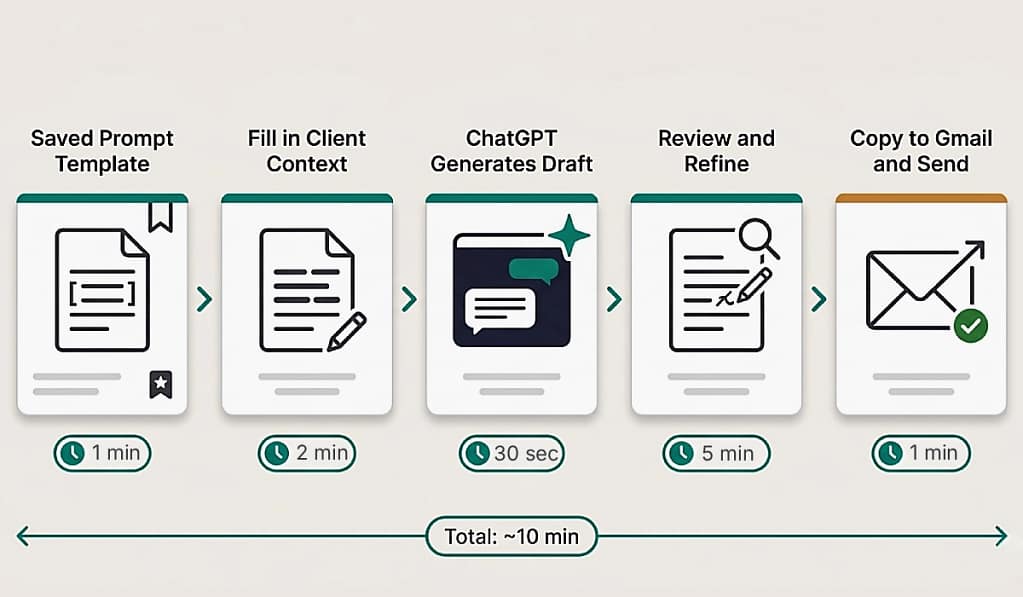
This is the fastest ChatGPT virtual assistant workflow to implement because it requires no tools, no automation, and no configuration, just a saved prompt template opened at the start of every email drafting session.
The process:
- Open ChatGPT (browser or app)
- Open your saved “Client Email Draft” prompt template (saved in a Notion page or ClickUp document)
- Fill in the bracketed placeholders (client name, task list, tone, format)
- Submit, review the draft output
- Refine if needed (typically 1-2 sentence adjustments)
- Copy to Gmail, send
The behavioral shift: The VA never opens Gmail to start writing an email from scratch. Every email begins in ChatGPT. This single habit change produces the 45-90 minute daily time saving without any additional setup.
Workflow 2 — The Weekly Report Pipeline (ChatGPT + Make)
Type: Automated integration
Setup time: 2-3 hours (Make scenario)
Weekly time saved: 1-2 hours per client
MAKE SCENARIO:

TRIGGER: Make Scheduler — Friday 3:00 PM

MODULE 1: ClickUp — Get completed tasks
Filter: Status = Done
        Completed this week
        List = [Client list]

MODULE 2: Iterator — Process each task
Extract: task name + completion date

MODULE 3: Aggregator — Build task list string

MODULE 4: HTTP — ChatGPT API
System prompt: "You are a professional virtual assistant writing client reports. Always use professional, concise language. Never use filler phrases."

User message: "Generate a weekly client report email for [CLIENT NAME].
Completed tasks this week: [AGGREGATED TASK LIST]
Client primary goal: [FROM PROMPT CONFIG]
Tone: [CLIENT TONE PREFERENCE] [USE WEEKLY REPORT TEMPLATE FROM SECTION 8]"

MODULE 5: Gmail — Create draft
To: [client email]
Subject: [from ChatGPT output]
Body: [from ChatGPT output]
Status: DRAFT (not auto-send — VA reviews before sending)

MODULE 6: Slack — Notify VA "📊 Weekly report draft ready for [CLIENT NAME] — review in Gmail"
Note: the report is created as a Gmail draft, not sent automatically. The VA reviews and sends, maintaining quality control without the writing effort.
Workflow 3 — The SOP Factory (ChatGPT + Notion)
Type: Manual integration with structured process
Setup time: 30 minutes (Notion template setup)
Time saved per SOP: 2-3 hours
The SOP Factory is a repeatable process for generating client-specific Standard Operating Procedures at scale, using ChatGPT for generation and Notion for storage and retrieval.
Setup (one-time, 30 minutes):
- Create a Notion database called “SOP Library”
- Properties: Client, Process Name, Frequency, Last Updated, Status
- Create a template page with the SOP structure from the prompt in section 9
- Save the SOP Generator prompt as a Notion page in “Prompt Library”
The process (per SOP, 15-20 minutes):
- Open the SOP Generator prompt in Notion
- Fill in the process description and client context
- Submit to ChatGPT
- Review output, adjust any client-specific details
- Create new SOP page in Notion from template
- Paste ChatGPT output
- Tag with Client + Process Name + Frequency
Result: a searchable, updatable SOP library for every client, built from AI-generated first drafts, maintained in Notion.
Workflow 4 — The Content Repurposing Machine (ChatGPT + Zapier)
Type: Semi-automated Setup time: 45-60 minutes (Zapier) Time saved: 1-2 hours per content piece
For VAs managing social media or content for clients, the content repurposing workflow turns a single long-form input (blog post, newsletter, podcast transcript) into a full set of platform-specific content assets automatically.
ZAP STRUCTURE:

TRIGGER: Google Drive — New file in folder: "Content to Repurpose — [Client Name]"

ACTION 1: Google Drive — Get file content (extracts text from Google Doc)

ACTION 2: ChatGPT via Zapier AI Action
Prompt: "You are a content strategist for [CLIENT NAME], a [INDUSTRY] brand.
Your tone is [BRAND VOICE].

Repurpose the content below into:
1. LinkedIn post (150-200 words, professional tone, 1 CTA at end)
2. Twitter/X thread (5-7 tweets, conversational, each under 280 chars)
3. Instagram caption (80-120 words, engaging, 5 relevant hashtags at end)
4. Newsletter intro paragraph (100-150 words, warm and direct)

Original content: [Google Doc text]"

ACTION 3: Google Docs — Create new document
Name: "Repurposed — [original filename] — [date]"
Content: [ChatGPT output]
Location: Client content folder

ACTION 4: Slack — Notify
"Content repurposed for [CLIENT NAME] — review doc in Drive: [link]"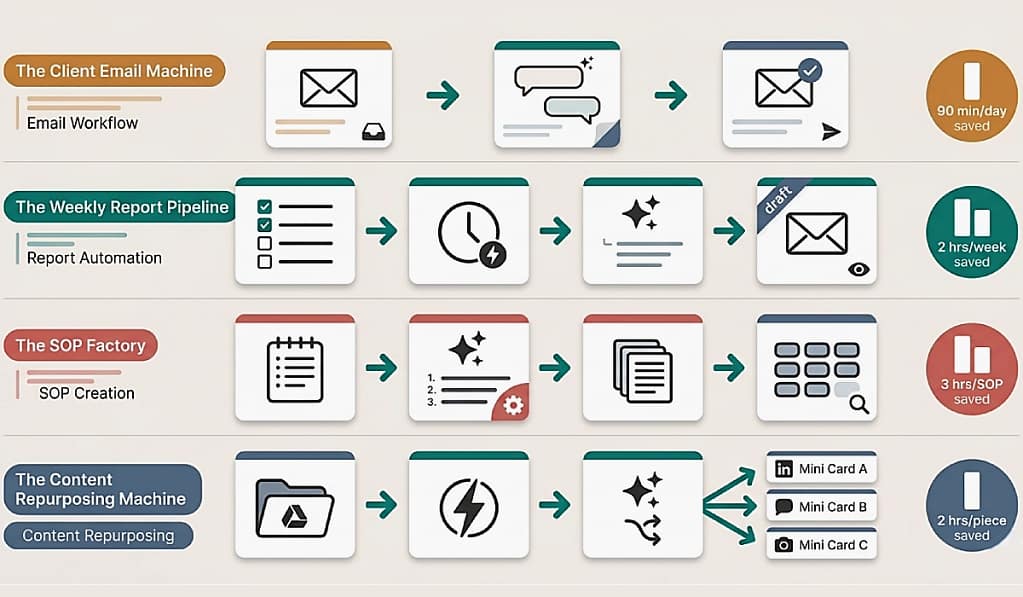
These workflows are the starting point. The Free AI Toolkit includes the prompt templates, the ClickUp configuration guide, and the Make scenario structure you need to implement them today, without building from scratch.
11. How to Set Up ChatGPT for Your VA Business
Setting up ChatGPT for consistent, professional use in VA operations requires more than creating an account. The five steps below build the configuration layer that makes ChatGPT a reliable daily tool rather than an occasional one.
Step 1 — Create Your Account and Choose Your Plan
The first step in setting up ChatGPT for virtual assistants is creating your account at chat.openai.com and selecting the right plan. Start with the Free plan for the first week to test output quality and frequency of use. If you find yourself hitting message limits or needing web browsing for client research tasks, upgrade to Plus ($20/month).
The upgrade pays for itself within the first two to three working days of use at typical VA email volume.
Step 2 — Configure Memory with Your VA Profile
Go to Settings → Personalization → Memory and enable Memory. Then open a new chat and submit this configuration prompt:
Please remember the following about me and use it in all future conversations:I am a virtual assistant.My name is [NAME].My primary services: [LIST YOUR SERVICES]My typical clients: [INDUSTRY / PROFILE]My tone of voice: [e.g., warm-professional, direct, formal]My primary tools: [ClickUp / Notion / Gmail / Slack / Zapier / Make]My working hours: [TIMEZONE + HOURS]When drafting emails or client communication, always match my tone of voice above.When generating task lists, always format for ClickUp import (checkbox markdown).When generating SOPs, always use the structure: Purpose / Frequency / Trigger / Tools / Steps / Quality Check.
After submitting, verify ChatGPT confirms it has saved the information. Test with a simple email drafting prompt to verify the tone is correctly applied.
Step 3 — Build Your Prompt Library
Create a dedicated Prompt Library document in Notion or Google Docs with one section per task category. Copy the prompts from sections 6-9 of this guide as your starting set.
Structure:
– Email Management (4 prompts)
– Client Communication (4 prompts)
– Task Management (3 prompts)
– Research and Documentation (3 prompts)
– Social Media (add from use case section)
Label each prompt with the task type and estimated time saving. Update the library as you refine prompts with specific client preferences.
Step 4 — Build Your First Custom GPT
In ChatGPT Plus, go to Explore GPTs → Create. Build one Custom GPT for your highest-frequency task. Recommended for most VAs: a “Client Email Assistant” Custom GPT with these instructions:
You are a professional virtual assistant specializing in client email management.Always apply these defaults:- Tone: [VA's tone preference]- Length: concise — under 200 words unless a report format is specified- Opening: never use "I hope this finds you well" or similar filler- Closing: always end with one specific next action or request- Format: subject line always included Client roster (update as needed):- [CLIENT A]: [service type, tone preference]- [CLIENT B]: [service type, tone preference]- [CLIENT C]: [service type, tone preference]When asked to draft an email for a specific client, automatically apply that client's tone and context without being asked.
Step 5 — Integrate with Your Daily Workflow
ChatGPT is most effective when it is integrated into the daily operational flow rather than used reactively. Establish these three integration points:
Morning (5 minutes): submit the Daily Briefing prompt from section 8 with your task list and calendar. Use the output as your operating plan for the day.
During email time (per email): open the Client Email Draft prompt, fill in the context, generate, review, refine, send. Never draft from scratch again.
End of week (Friday): submit the Weekly Report prompt for each client. Review the drafts, send. The reporting cycle becomes a 20-30 minute task instead of a 2-3 hour one.
12. Common Prompting Mistakes VAs Make
The difference between a ChatGPT prompt that produces a usable first draft and one that produces a generic output requiring complete rewriting is almost always structural. These six mistakes are the most common reasons ChatGPT outputs require more editing than the prompt-writing time saved.
Mistake 1 — No Role Specification
Submitting “Write an email to my client about the project update” without specifying who ChatGPT should act as produces a generic corporate email that sounds nothing like a VA’s professional voice.
The fix: always open with “Act as a professional virtual assistant…” or “You are an experienced VA supporting a [INDUSTRY] client…” Role specification immediately shifts tone, vocabulary, and output structure toward the VA professional context.
Mistake 2 — No Format Instruction
Without a format instruction, ChatGPT makes its own structural choices, sometimes producing 5 paragraphs when you needed 2, sometimes a bullet list when you needed prose, sometimes a formal tone when you needed warm.
The fix: always end the prompt with an explicit format instruction: “Output as: subject line + 3 paragraphs — action item list. Under 200 words. Professional but warm tone.” The format instruction is the single most impactful addition to any prompt.
Mistake 3 — Accepting the First Output Without Iteration
The first ChatGPT output is a draft, not a final deliverable. VAs who send the first output without review produce AI-detectable, generic content that does not reflect their voice or the client’s context.
The fix: treat ChatGPT like a junior VA whose draft you review before anything leaves your desk. Use one-line follow-up prompts to refine: “Make this 30% shorter.” “Adjust the tone to be more direct.” “Add a specific call to action at the end.” “Remove the second paragraph, it’s redundant.” Iteration takes 60 seconds and transforms the output.
Mistake 4 — Including Sensitive Client Data in Prompts
Pasting client contracts, financial data, personal information, or confidential strategy documents into ChatGPT prompts violates data privacy principles and potentially your client agreements.
The fix: replace identifiable information with placeholders in prompts submitted to ChatGPT. Use [CLIENT NAME] instead of the actual name, [AMOUNT] instead of specific financial figures, [PROJECT NAME] instead of confidential project names. The output quality is identical, the risk is eliminated. If you work with clients who have strict data requirements, use ChatGPT Business (data not used for training) or evaluate Claude’s privacy terms.
Mistake 5 — Using ChatGPT for Real-Time Research Without Web Browsing Enabled
ChatGPT’s training data has a knowledge cutoff. Asking for current competitor pricing, recent industry news, or updated tool features without web browsing enabled produces plausible-sounding but potentially outdated information.
The fix: enable web browsing in Plus (Settings → default on for Plus users). Always verify research outputs against the original sources before delivering to clients, ChatGPT with web browsing is a research accelerator, not a fact source.
Mistake 6 — One Prompt for Multiple Tasks
Asking ChatGPT to “write a weekly report, create a task list for next week, and draft the follow-up email for Client A” in a single prompt produces a compromised version of all three rather than a high-quality version of any one.
The fix: one task per prompt. The 30 seconds spent submitting three separate prompts produces three better outputs than one combined prompt produces three mediocre ones. If you need multiple outputs for the same client, use the “same context” efficiency: set the context once (“I’m working on [CLIENT A] operations.”), then submit the individual task prompts sequentially in the same conversation.
13. ChatGPT vs Other AI Tools for Virtual Assistants
ChatGPT is not the only AI tool in a VA’s stack, it is the general-purpose layer. Each specialized tool has a specific context where it outperforms ChatGPT, and understanding this matrix prevents both under-utilization (using only ChatGPT for everything) and over-complication (using five tools for tasks ChatGPT handles better).
Tool | Primary Strength | Best VA Use Case | When to Choose Over ChatGPT |
ChatGPT | Versatile generation + transformation | Email, reports, SOPs, proposals, content | Default for all general text tasks |
Claude | Complex structured reasoning + long-form | Multi-section documents, data analysis, complex prompt logic | When output needs high structural precision or handles 10,000+ word contexts |
Notion AI | Native integration with Notion workspace | In-Notion docs, meeting notes, database queries | When working inside Notion — eliminates copy-paste |
ClickUp AI | Native task management integration | Task summaries, action items from briefs, project descriptions | When working inside ClickUp — auto-creates tasks |
Perplexity | Real-time research with citations | Current data, news, competitor research with sources | When research requires verifiable, cited current information |
The recommended stack configuration for most VAs:
ChatGPT Plus as the primary daily driver: email, communication, reports, planning, and all general text tasks.
Claude as the secondary tool for tasks requiring high structural precision: complex multi-section SOPs, long-form client documentation, prompt logic that requires multi-step reasoning.
Notion AI active if the VA’s primary workspace is Notion, saves the copy-paste step for in-workspace tasks.
ClickUp AI active if the VA uses ClickUp as the primary task management hub, generates task descriptions and summaries natively.
Perplexity or ChatGPT with web browsing for all research tasks requiring current, citable information.
👉 AI Tools for Virtual Assistants: The Complete Practical Guide — the full tool stack reference, organized by task category and use case.
14. Conclusion
ChatGPT for virtual assistants is not a tool you learn once and deploy perfectly. It is a system that improves continuously as you refine your prompt library, configure Memory with more precise preferences, and integrate AI generation into more of your daily task types.
The ten use cases in this guide cover the full operational range of ChatGPT for virtual assistants, from the email drafting that produces the fastest immediate time saving to the SOP creation and client proposals that elevate the quality of your service delivery.
The 20+ prompt templates in sections 6-9 are starting points, not permanent fixtures. The most effective prompt library is the one built from your specific client roster, your service types, and your voice, refined through iteration over weeks of use.
Start with section 11, the five-step setup sequence, today. Configure Memory, build the first Custom GPT, integrate ChatGPT into your email process as the first operational habit. Within five working days, the daily time saving will be visible. Within four weeks, the compound effect of consistent AI-first workflows will be measurable.
ChatGPT is one layer of a complete AI-powered VA operation. The guides below show how it connects to the rest of your system:
👉 AI Powered Productivity System for Virtual Assistants — the five-layer framework that integrates ChatGPT with your full task management, communication, and reporting stack
👉 Best Automation Workflows for Virtual Assistants — the Zapier and Make workflows that connect ChatGPT to ClickUp, Gmail, and your client operations automatically
Frequently Asked Questions About ChatGPT for Virtual Assistants
Is ChatGPT free for virtual assistants?
ChatGPT for virtual assistants is available on a Free plan that is fully functional for testing and low-volume use, but the $20/month Plus plan is the operational threshold for daily professional use.
The three features that justify Plus for VAs (web browsing, Memory, and Custom GPTs) collectively save more time per week than the plan costs in the first week of consistent use.
For a VA billing $25-50/hour, recovering two hours per month from the Plus features covers the cost with significant margin.
Can I use ChatGPT with my existing tools like ClickUp, Notion, and Gmail?
Yes, at two levels. Direct integration: copy ChatGPT output into your tools manually. This requires no setup and works immediately for email drafting, task list generation, and document creation.
Automated integration: connect ChatGPT to your tools via Zapier or Make to trigger AI generation automatically (for example, generating a weekly report from ClickUp tasks and delivering it to Gmail as a draft).
The automated level requires 1-3 hours of setup per workflow but eliminates the manual step entirely.
How do I keep client data safe when using ChatGPT?
Use placeholders for all identifiable client information — [CLIENT NAME], [COMPANY], [AMOUNT] — instead of actual data in prompts submitted to the Free or Plus plans. For clients with strict data privacy requirements (legal, financial, healthcare), use ChatGPT Business or Team plans, where conversation data is not used to train OpenAI models. Always review your client contracts for any AI tool usage restrictions before using ChatGPT on client work.
How long does it take to learn ChatGPT as a virtual assistant?
Basic operational proficiency, producing useful first drafts for emails and routine communications, takes approximately two to three days of active daily use.
Building a full prompt library for your specific service types takes two to four weeks.
The performance plateau, where your prompts consistently produce near-final-quality outputs, is typically reached in four to eight weeks of daily use. The learning curve is driven by iteration: each prompt you refine and save makes the next similar task faster.
Should I tell my clients I use ChatGPT?
This is a judgment call based on client relationship and contract terms. There is no obligation to disclose the use of AI tools for drafting and internal operations, just as there is no obligation to disclose which project management tool you use.
The relevant question is whether the final deliverable meets the quality and accuracy standard the client expects, and whether your client contract includes any AI usage restrictions. For content delivered under the client’s name (blog posts, social media, newsletters), some clients have explicit preferences about AI use, clarify in the onboarding conversation rather than assuming.
What is the difference between ChatGPT and a Custom GPT?
ChatGPT is the general-purpose AI with no pre-loaded context about you, your clients, or your working standards.
A Custom GPT is a version of ChatGPT you configure with standing instructions, context, and behavioral rules that apply automatically to every prompt you submit.
For a VA, the practical difference is significant: a “Client Email Assistant” Custom GPT already knows your tone, your clients’ names and preferences, and your formatting standards, so every email prompt produces a context-aware draft without re-explaining the setup. Custom GPTs are available on the Plus plan and above.
Glossary: Key ChatGPT Terms for Virtual Assistants
Prompt The text input submitted to ChatGPT to generate a response. The quality, specificity, and structure of the prompt directly determines the quality of the output.
Prompt Library A collection of saved, tested prompt templates organized by task category. The VA’s primary productivity asset for ChatGPT operations, replaces blank-page prompting with reliable, refined templates for every recurring task type. Building a prompt library is the highest-leverage productivity investment a VA can make when adopting ChatGPT for virtual assistants as a daily work tool.
Custom GPT A personalized version of ChatGPT configured with standing instructions, context, and behavioral rules. Available on Plus and above. The recommended setup for any recurring task type with specific quality requirements.
Memory A ChatGPT feature that stores information about the user across conversations. For VAs, the critical configuration: tone of voice, client roster, tool preferences, and output format standards, so every session starts from a briefed baseline rather than zero.
System Prompt The standing instruction set that tells ChatGPT how to behave in every interaction. Equivalent to the standing instructions in a Custom GPT but submitted at the start of a session rather than pre-configured. Used in API integrations (Zapier, Make) to set ChatGPT’s operational context for automated workflows.
Context Window The maximum amount of text ChatGPT can process in a single conversation, input (your prompts) plus output (its responses). GPT-4o has a large context window (approximately 128,000 tokens, enough for very long documents and extended multi-turn conversations). For VAs, this means ChatGPT can process full email threads, long meeting transcripts, and multi-section documents in a single session.
Temperature A setting that controls the randomness of ChatGPT’s outputs, higher temperature produces more varied, creative responses; lower temperature produces more consistent, predictable outputs. In the standard ChatGPT interface, temperature is managed by the VA through prompt instructions (“Be creative and varied” vs “Be consistent and factual”). In API integrations, temperature is set as a numeric parameter.
Token The unit ChatGPT uses to measure text length, roughly equivalent to 0.75 words in English. Used to calculate context window limits and API pricing. Not directly relevant to standard ChatGPT interface use but important for VAs building automation workflows that use the ChatGPT API.
Web Browsing A ChatGPT Plus feature that enables real-time internet access for research tasks. Essential for VAs performing current competitor research, fact-checking, and market analysis for clients. Without web browsing, ChatGPT’s outputs are based on training data with a knowledge cutoff date.
GPT Actions A Custom GPT capability that connects the GPT to external APIs, enabling it to retrieve data from or take actions in external systems (CRM, project management tools, calendars) directly from a ChatGPT conversation. The integration layer between ChatGPT and a VA’s tool stack without requiring a separate automation platform.
Ready to Work Smarter as a Virtual Assistant?
Get the free AI Starter Toolkit and learn how to use simple AI tools and workflows to save time and deliver more value to your clients.
About the Author
Alex Stratton has spent the better part of a decade working at the intersection of virtual assistance and operational systems, first as a VA supporting founders and small business owners, then as a workflow consultant helping remote teams reduce the manual overhead that accumulates when businesses grow faster than their processes. The tools and workflows here reflect decisions made repeatedly in real client contexts, where the wrong choice costs hours, not minutes. Learn more about VA Automation Lab → About.